
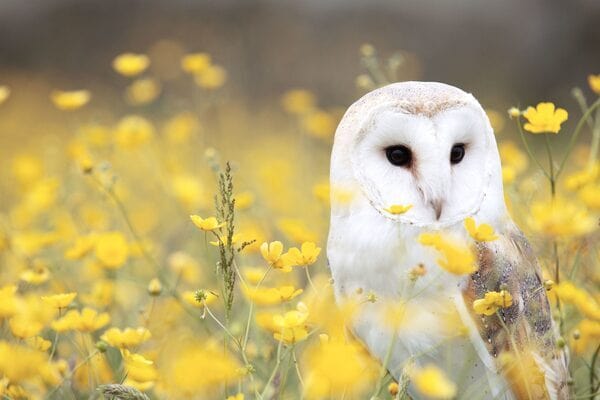
People often assume that owls, like many birds, might eat a mix of foods. But when you look at how owls live, hunt, and digest their meals, the answer becomes very clear: owls are not omnivores. Every species studied so far from tiny Elf Owls to large Great Horned Owls relies entirely on animal prey. Their pellets, observed across decades of research, consistently contain bones, fur, feathers, insect shells, or fish scales, but never evidence of intentionally eaten plant matter. When bits of seeds or plant fibers appear, they always come from inside the stomachs of the animals the owl swallowed.
Owls simply have no biological equipment to handle vegetation. They do not have grinding teeth, they cannot break down cellulose, and they do not show any feeding behavior that points toward plant eating. For biologists, this makes owls obligate carnivores animals that must rely on meat to survive.
The Biological Traits That Leave No Doubt: Owls Are Carnivores
If you observe an owl closely its feet, beak, eyes, or the way it processes food the carnivore label becomes obvious. Their talons are not general-purpose tools; they are precision weapons built to grab, pierce, and hold struggling prey. The beak follows the same logic: instead of a broad, versatile shape seen in omnivores, owls have a sharply hooked upper mandible meant for tearing muscle and skin.
Their internal biology tells the same story. Owls swallow prey mostly whole because they cannot chew. Later, their stomach separates digestible tissue from bones, fur, and other hard parts. The waste is compacted and expelled as a pellet a feeding behavior seen only in carnivorous birds.
Even their senses point to a meat-based lifestyle. The broad facial disc that funnels sound into their ears, the forward-facing eyes for depth perception, and the extremely quiet flight feathers are all tied to one purpose: hunting other animals, usually at night.
Key signs of a true carnivore:
- Talons shaped for gripping and killing
- A hooked beak that tears flesh, not plants
- No grinding teeth for breaking down vegetation
- A digestive system designed for animal protein
- Pellet production that removes indigestible prey parts
- Night-adapted vision and hearing for tracking moving animals
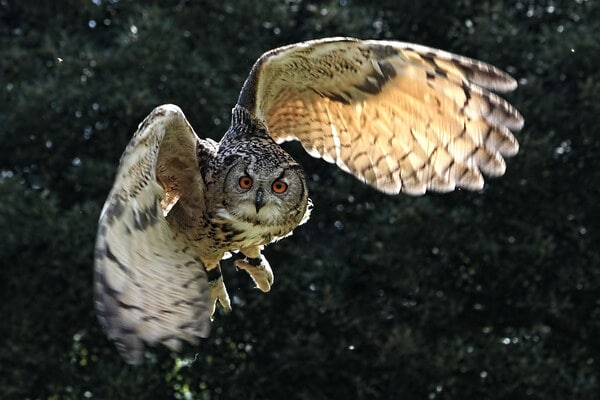
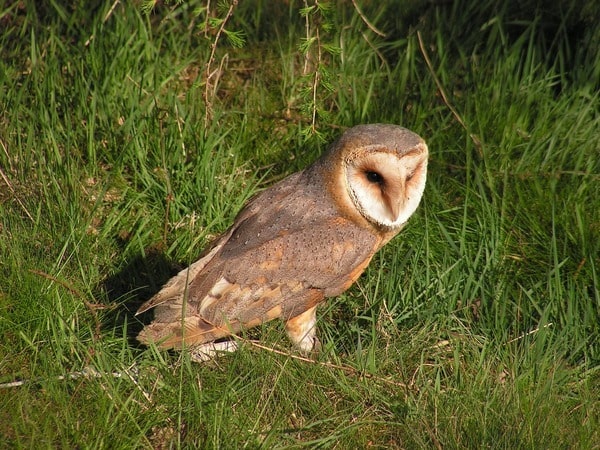
How Evolution Shaped Owls Into One of Nature’s Most Specialized Carnivores
Owls didn’t become carnivores by accident. Their family tree shows a long history of predatory ancestors, and over millions of years, natural selection refined them into specialists. Fossil evidence from early owl-like birds already shows forward-facing eyes, curved claws, and hooked beaks traits of predators rather than omnivores.
As owls adapted to nighttime hunting, their bodies changed further. Their wings evolved edges that reduce wind noise, giving them an advantage over alert prey. Their hearing became asymmetrical, allowing them to pinpoint the exact location of a mouse beneath leaves or snow. None of these adaptations help an animal eat plants; all of them help a hunter catch and consume live prey, which also explains why questions like Do Owls Eat Fish come up when considering the full range of their hunting abilities.
This evolutionary path also explains why owls cannot shift into an omnivorous lifestyle the way crows, ravens, or gulls can. They are too specialized. Their survival depends on accessing reliable sources of protein and fat, not fruit or seeds.
Evolutionary features that confirm their carnivore path:
- Silent flight designed for ambushing prey
- Facial discs evolved for pinpoint acoustic hunting
- Forward-facing vision for judging distance
- Specialized digestion for meat, not plant material
- Ancestral lineage dominated by predatory traits
- Dependence on prey availability in every habitat
Related Post
- How Much Can A Owl Carry – Read This Explanation
- Flammulated Owl : A to Z Guide
- Rufous Legged Owl : Everything You Need To Know
- Greater Sooty Owl : A to Z Guide
- Rufous Owl : A to Z Guide
- Do Owls Attack Humans : Let’s Understand It Why
Resources
- reference.com
- reference.com