

Owls do eat squirrels, and this is well-supported by pellet studies, wildlife reports, and field observations across North America, Europe, and boreal regions. Larger owl species like the Great Horned Owl, Barred Owl, Northern Hawk Owl, and Eurasian Eagle-Owl have the strength and stealth needed to take a squirrel when the timing is right. It isn’t something that happens constantly, but it happens naturally in the wild, especially around dawn or dusk when squirrel activity overlaps with peak owl hunting hours.
Squirrels usually stay protected in tree hollows or dreys at night, but the moment they climb, cross open branches, or travel near the ground during low-light periods, the risk increases. Owls take advantage of those short, vulnerable moments.
Which Owl Species Commonly Hunt Squirrels?
Some owls are built for small prey like mice and voles, while others are strong enough to handle something as quick and agile as a squirrel. Only a few species consistently show squirrel remains in pellet analyses or are documented taking them in the field.
The Great Horned Owl is the most capable. It’s one of North America’s strongest owls, known for taking gray, red, and fox squirrels when the opportunity appears. Its talons exert tremendous pressure, and it often strikes from a high perch where squirrels don’t expect danger.
Barred Owls also take squirrels, though usually smaller or younger individuals. They hunt from deep woods into suburban edges, slipping between trees quietly until they’re close enough to launch an ambush, a behavior often discussed when people ask Do Barred Owls Eat Squirrels in mixed woodland habitats.
The Northern Hawk Owl is different because it hunts during the day. This overlap with squirrel activity makes daylight squirrel hunts one of the most commonly reported behaviors for this species in boreal forests.
And then there’s the Eurasian Eagle-Owl one of the world’s largest owls. It’s strong enough to lift prey much heavier than a squirrel, so catching one isn’t difficult in regions where both animals share habitat.
These species appear repeatedly in wildlife records, confirming that squirrel predation is not rare or accidental it’s part of the natural diet in many habitats.
How Owls Catch Squirrels: Hunting Techniques Explained
Squirrels are incredibly fast, sharp-eyed, and agile in trees. Owls overcome that advantage by relying on skills squirrels simply can’t detect until it’s too late.
They usually hunt from a high perch, remaining still until a squirrel crosses a branch that exposes it. When the owl dives, its specialized feathers let it drop through the air with almost no sound. Most squirrels don’t even react until the owl is already in striking range.
A few things help the owl succeed:
- A downward attack that uses gravity and speed
- Silent wings that prevent warning sounds
- Talons strong enough to immobilize the squirrel on impact
- Perfect timing, often choosing moments when squirrels are distracted or transitioning between branches
Owls don’t chase squirrels through the canopy the way hawks might. They depend on a single, perfectly timed ambush quick, silent, and decisive.
How Owl Vision and Hearing Help Them Locate Squirrels
Owls detect squirrels long before they strike. Their sensory system is built for low-light hunting, which lines up exactly with the times when squirrels are most exposed early morning and late evening.
Their night vision is extremely sharp thanks to rod-rich retinas, allowing them to see slight movements when light levels drop. The asymmetrical ear placement helps them pinpoint the faintest sounds like a squirrel scratching bark or rustling leaves. Their facial discs channel sound directly into the ears, making it easier to locate prey hidden behind branches or partial cover.
This combination of hearing and vision gives owls an advantage even when squirrels believe they are safely camouflaged.
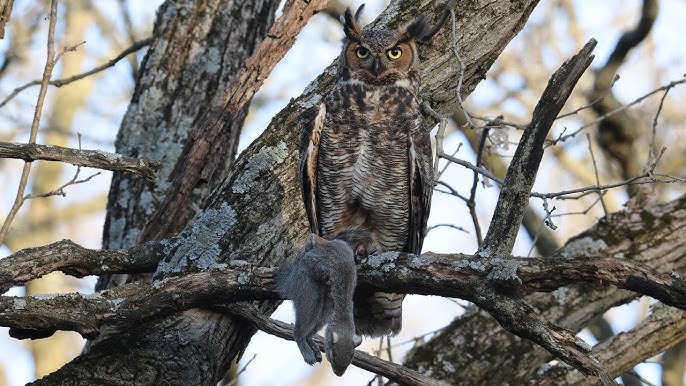
Can Owls Catch Squirrels During the Day?
They can but it depends on the species.
Most owls avoid broad daylight. However, the Northern Hawk Owl is a true daytime hunter and one of the few owls documented catching squirrels under full sunlight. This species relies more on sight than sound, scanning tree lines for any movement.
Larger nocturnal owls like Great Horned or Barred usually hunt at dawn or dusk, but they may extend into early morning during winter or breeding season. That overlap is enough for occasional daytime captures, especially when squirrels linger outside their nests longer than usual.
So no, it’s not common for most owls, but it is absolutely possible and well-documented for specific species and certain circumstances.
Seasonal Factors: When Owl Attacks on Squirrels Increase
Predation isn’t random. Wildlife observations show that owl attacks on squirrels spike during certain times of year, mostly because of changes in behavior and availability.
In winter, squirrels often forage longer and closer to dusk because food is harder to find. This makes them vulnerable when owls are just beginning their nightly hunt. Leafless trees also remove the canopy cover squirrels rely on for protection.
During owl breeding season, adults need more food for their chicks. This sometimes pushes larger owls to target bigger prey, including squirrels, especially if smaller mammals are scarce.
And when juvenile squirrels first leave the nest in late spring or summer, they move clumsily and take risks adults usually avoid. This creates easy opportunities for owls.
All these small seasonal shifts create windows where owl–squirrel encounters naturally increase.
If you want to explore how winter affects squirrel behavior, read the full study here: Click Here
Real Cases of Owl-Squirrel Predation Reported by Wildlife Agencies
Multiple wildlife departments, rehab centers, and ecological studies have recorded confirmed squirrel predation.
Great Horned Owl pellets consistently show squirrel remains in forested and suburban regions. Barred Owls often appear in reports involving juvenile gray squirrels, especially near woodland edges. Northern Hawk Owls are frequently documented catching red squirrels in daylight across boreal forests one of the clearest examples of squirrel predation in any owl species.
In Europe, Eurasian Eagle-Owl studies list squirrels as regular prey in mixed forests, especially when rabbit or hare populations dip.
These reports confirm what field biologists have seen for decades: squirrels are not a primary food source for owls, but they are absolutely part of their natural diet.
For documented owl diets that include squirrels, see the study here: Click Here
Related Post
- Can Owls Move Their Eyes – Read The Answer
- How Much Can A Owl Carry – Read This Explanation
- Flammulated Owl : A to Z Guide
- Rufous Legged Owl : Everything You Need To Know
- Greater Sooty Owl : A to Z Guide
Resources
kidzfeed.com