
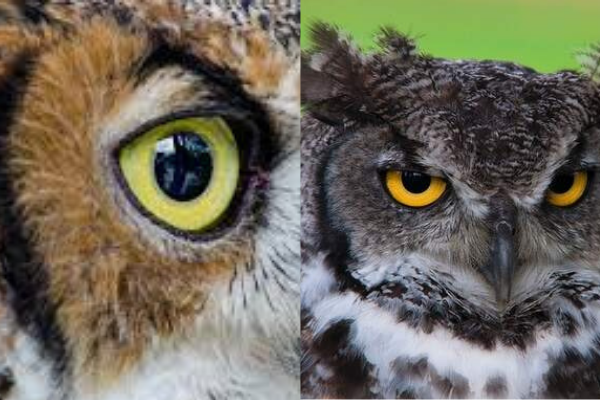
Owls are famous for their unblinking stare, and there’s a real scientific reason behind it: they cannot move their eyes. Instead of round, movable eyeballs like ours, an owl’s eyes are shaped like long tubes and are held firmly in place by sclerotic rings bony structures found in many birds. Because their eyes don’t rotate in the socket, an owl’s gaze always points straight ahead.
But this limitation comes with a powerful advantage. Their fixed, forward-facing eyes create true binocular vision, helping them judge distance precisely, even in extremely low light. To look around, owls rely on their exceptionally flexible necks, which can rotate up to 270 degrees without cutting off blood flow an adaptation confirmed by anatomical studies.
This design isn’t a flaw; it’s evolution’s way of giving owls incredible night-hunting accuracy. Their steady stare isn’t meant to intimidate-it’s simply how one of nature’s most efficient nocturnal predators sees the world.
Can Owls Really Not Move Their Eyes The Simple Science Behind Their Famous Stare
Most animals can shift their eyes side to side or up and down, but owls cannot. Their eyes are shaped like elongated tubes rather than round balls. These tubes are held firmly in place by a ring of bone called the sclerotic ring which prevents any eye rotation. Because of this structure an owl’s gaze always points straight ahead.
This fixed eye design gives owls a major advantage at night. Tubular eyes allow for a larger lens and more light intake which dramatically improves low light vision. Their forward-facing eyes also provide strong binocular depth perception which helps them judge distance perfectly during hunts.
To compensate for immobile eyes owls move their necks instead. Their neck contains twice as many vertebrae as ours which lets them rotate their head up to 270 degrees without cutting off blood flow or damaging nerves.
Quick facts users love to know
• Owl eyes are tubular not spherical
• Sclerotic rings lock the eyes in place
• Head rotation replaces eye movement
• Fixed forward vision improves depth perception
Owl Eyes Don’t Move So How Do They Hunt So Well
Even though an owl cannot move its eyes in the way humans do, it is one of the most efficient nocturnal hunters on the planet. An owl’s eyes are long and tube shaped and are held rigidly in place by a ring of small bones called the sclerotic ring. That fixed forward gaze is not a defect. It lets an owl pack bigger optics into its skull so the eye can gather far more light and produce a clearer, more detailed image in dim conditions.
Because the eyes do not swivel, owls rely on an extraordinary combination of head mobility, hearing and flight adaptations. Their neck anatomy is built to rotate much farther than a human neck can, often up to 270 degrees in either direction. Special vascular and skeletal adaptations prevent blood vessels from being severed during such extreme rotation. This makes head turning the primary way owls change their viewpoint while the eyes themselves remain fixed.
Hunting at night demands more than just big eyes. Owl retinas contain a high density of rod cells that are very sensitive to low light. In many owl species there is also a reflective layer behind the retina that gives incoming light a second chance to be detected. That combination makes nocturnal shapes and tiny motions far easier to spot than they would be to a human observer.
Sound completes the system. Many owl species have facial feathers shaped into a disc that funnels sound to asymmetrically placed ears. That head shaped funnel plus precise neural processing lets an owl localize prey by ear with astonishing accuracy, even when vision is limited. In practice the owl will lock its fixed gaze on a general area, rotate its head to refine angle and distance, and then dive with near silent flight to capture the target.
How owls stay accurate without moving their eyes
• Neck rotation covers nearly the whole surrounding view which makes the fixed gaze effectively comprehensive.
• Large, forward facing tube eyes increase binocular overlap for precise depth perception at night.
• A high concentration of rods and often a reflective retinal layer boost sensitivity in very low light.
• Facial discs and asymmetrical ears let owls pinpoint prey by sound, sometimes even under vegetation or snow.
• Specialized feathers and wing structure enable silent approach so the owl’s steady gaze and hearing are not ruined by the sound of its own flight.

What Makes Owl Eyes So Different and Why They Seem to Stare Right Through You
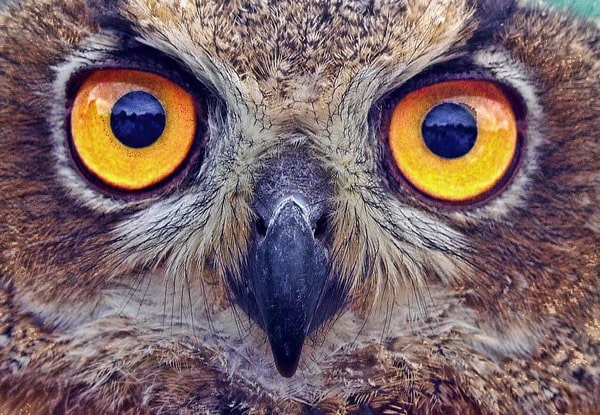
People often describe an owl’s stare as intense or unsettling, and there is a real biological reason behind it. Owl eyes do not move inside the socket the way human eyes do. They stay fixed in one position which naturally creates a focused, unwavering gaze. Because of this fixed structure an owl appears to lock eyes with anyone in front of it even when it is simply looking straight ahead.
What makes the stare even stronger is the size of their eyes. Relative to body size, owl eyes are among the largest of any bird. In species like the great horned owl, the eyes are so large that they occupy a major portion of the skull, leaving little space for muscular movement within the Owl Skeleton. Bigger eyes allow a larger lens and more light to reach the retina, which dramatically improves image brightness and clarity in low light.
To humans this creates the illusion of emotion or deep attention. In reality the owl is not expressing anything. It is simply using the only visual posture its anatomy allows. The forward facing eyes provide excellent depth perception while the neck rotation helps the owl shift its view without changing the position of its eyes. That combination makes the stare seem to follow you effortlessly.
Why their stare feels so intense
• Large forward facing eyes dominate the facial structure
• Eyes remain fixed which gives the appearance of constant attention
• High sensitivity and clarity help create a sharp, focused look
• Head rotation makes their forward gaze shift smoothly toward new angles


Related Post
- How Much Can A Owl Carry – Read This Explanation
- Flammulated Owl : A to Z Guide
- Rufous Legged Owl : Everything You Need To Know
- Greater Sooty Owl : A to Z Guide
- Rufous Owl : A to Z Guide
- Do Owls Eat Birds : Let’s Understand Why