
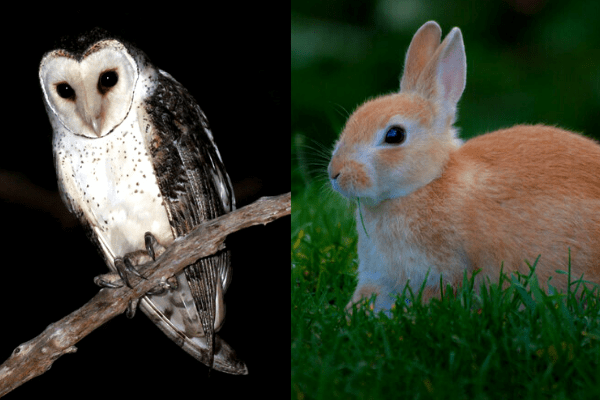
Yes-many owls do eat rabbits. Larger owl species commonly take rabbits as part of their diet, while smaller owls mostly take young kits when available. The exact importance of rabbits in an owl’s diet depends on the owl species, local rabbit abundance, season and habitat.
Which Owl Species Commonly Hunt Rabbits?
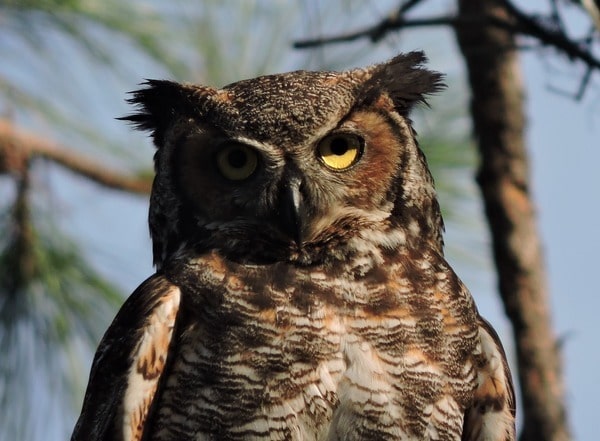
Great Horned Owl (Bubo virginianus). One of the most frequently cited raptors that takes rabbits and hares along with rodents and other mammals. Field diet studies and regional reviews list rabbits among its common prey.
Eurasian (or European) Eagle-Owl (Bubo bubo). In Mediterranean and many European habitats this large owl heavily relies on European rabbits where they are abundant. Long-term diet studies show rabbits can be a staple prey in some regions.
Snowy Owl (Nyctea scandiaca). Typically a lemming specialist during breeding, but in some areas and seasons will take larger mammals (including hares/rabbits) when they are available.
Other large or open-country owls. Short-eared, great gray, and some large Bubo and Strix species will include rabbits or young lagomorphs in their diets where habitat and opportunity allow. Pellet and nest-prey studies show variation by region and year.
(Smaller owls such as many Tyto and Aegolius species usually focus on rodents but will take rabbit kits opportunistically; pellet studies demonstrate this dietary partitioning.)
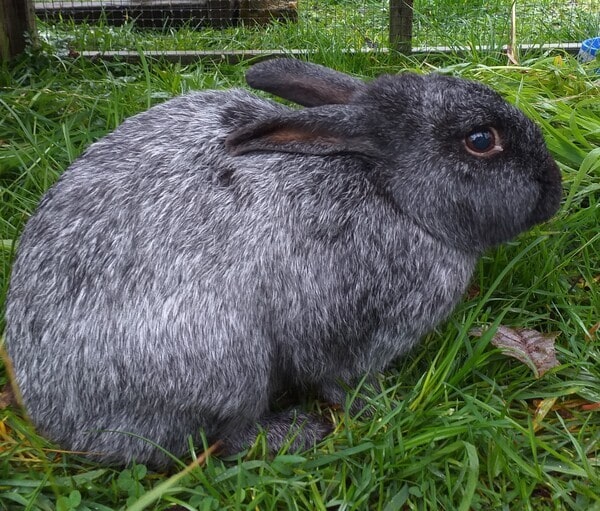
How Owls Hunt and Kill Rabbits: Tactics Explained
Owls use a combination of morphological and behavioural adaptations to catch prey including rabbits and several of these are well documented in scientific literature:
Silent flight. Specialized feather structure (leading-edge comb, velvet surface, and flexible fringes) reduces aerodynamic noise so an owl can approach without being heard. This is a major advantage for ambushing alert prey.
Exceptional hearing and vision: Night vision tuned to low light and, in many species, asymmetrical ear placement lets owls precisely locate prey by sound even under vegetation or snow. Experiments with trained barn owls and anatomical studies demonstrate how hearing maps to strike accuracy.
Stealthy perch-and-pounce or low-flight attack: Owls commonly hunt from perches or fly low over open ground, detecting movements or sounds of rabbits and then striking with a rapid, forceful plunge. Field observations and nest-prey studies describe these tactics.
Powerful talons and killing technique define how large owls handle prey. They have strong feet and talons used to grasp and kill, and when dealing with larger mammals they typically aim for the head, neck, or chest to subdue quickly. Post-mortem and observation records support this approach, which is often discussed in the context of whether Do Owls Eat Cats and how such rare but serious encounters could occur.
Can an Owl Carry a Full-Grown Rabbit?
Large owls can take full-grown rabbits, but there are limits and context matters:
Feeding vs. carrying: Some large Bubo owls and Great Horned Owls are capable of killing and carrying rabbits short distances to a perch or nest. Field diet studies document whole rabbits or large lagomorph remains in nests and pellets
Practical limits: An owl’s lift capability depends on body mass, wing area and prey shape. Most owls cannot carry prey many times their own weight for long distances; often large prey are consumed at or near the kill site or carried in stages. Observational literature and prey-item analyses indicate large owls sometimes handle rabbits but may dismember or cache parts rather than fly long distances with whole heavy prey.
Do Owls Target Baby Rabbits More Than Adults?
Yes -when choice is available. Younger rabbits (kits) are easier to kill and transport, so many owl species (including smaller species) take juveniles more often than full-grown adults when both are available. Studies of prey-size selection show predators often prefer subadult or smaller individuals when given the option.
But larger owls will take adults. Large owls are physically capable of killing adult rabbits and will do so, particularly when rabbit densities are high or when owlets are being provisioned. Field diet studies for eagle-owls and great horned owls record frequent adult rabbit remains in some regions/years.
How Often Do Owls Eat Rabbits in the Wild?
Frequency depends on species, region and rabbit abundance:
Species & ecosystem dependent. In ecosystems where rabbits are abundant (for example parts of southwestern Europe for the Eurasian eagle-owl), rabbits can form a large portion of the diet. In other regions, rodents dominate owl diets and rabbits are rare in pellet records. Long-term prey studies show this variability.
Yearly fluctuation. Rabbit populations can boom and crash (e.g., disease, hunting, habitat change). Owl diet composition follows these prey cycles; studies show owls switch prey or show lower breeding success when staple prey decline.
How we know: Pellet analysis, nest prey remains and direct observations are the main evidence sources scientists use to estimate how often owls eat particular prey types. These methods show rabbits as common prey in some regions and rare in others.
Signs an Owl Might Be Hunting Rabbits in Your Area?
Look for field signs typically used by wildlife biologists and naturalists:
Owl pellets containing rabbit bones. Dissecting pellets or inspecting prey remains under roosts/nests will show rabbit skull or limb bones if rabbits are eaten locally. Pellet studies are a standard method to track diet.
Rabbit carcasses with raptor marks. Uneaten or cached rabbit carcasses, often with talon punctures and plucking, can indicate owl predation (note: other raptors or mammals can also leave similar signs).
Frequent owl activity at dusk/dawn over open fields. Owls hunting low over open ground or perching near rabbit habitat suggest they are exploiting lagomorph prey.
Do Pet Rabbits Need Protection from Owls?
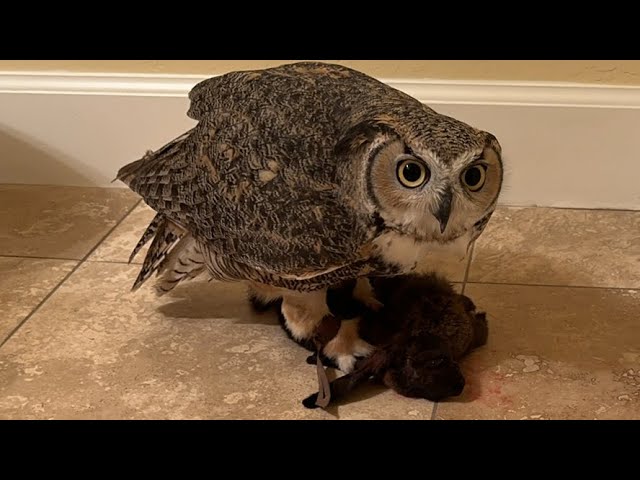
Short answer: Yes, if they are kept outdoors and are accessible at night. While not every area or household faces high risk, documented cases show owls occasionally attack and kill small pets, including rabbits. Securing outdoor hutches and providing covered enclosures substantially reduces risk.
What Owl Species Pose the Highest Risk to Outdoor Rabbits?
Great Horned Owl and other large Bubo species are often the main risk in North America and Eurasia where they overlap with domestic rabbits; they are large, powerful and willing to take mammals.
Local large owls (e.g., Eurasian Eagle-Owl, Short-eared Owl in open countryside) pose higher risk than small, forest-dwelling species. Risk depends on owl presence and rabbit accessibility at night.
Can an Owl Break Into a Rabbit Hutch?
Yes- if the hutch is poorly protected. Owls can peck, claw or reach through weak mesh/netting; they may pull apart low-quality roofs or gaps to reach an exposed rabbit. Veterinary and wildlife incident reports recommend solid roofs, fine mesh and fully enclosed runs to prevent such attacks. Documented incidents of pet rabbit predation by owls illustrate the need for good hutch construction and nighttime cover.
Practical protection tips (evidence-based):
- Keep rabbits indoors at night or use fully enclosed runs with a solid roof and predator-resistant mesh.
- Place hutches under cover or inside sheds when possible, especially during breeding season or when owls are active.
- Remove attractants (exposed food, unsecured compost) and monitor local owl activity-pellets or sightings near property are a signal to increase protection.
Real-World Reports of Owls Hunting Rabbits
1. Great Horned Owl Attacks Pet Rabbits in Alaska
A documented wildlife incident reported by the Alaska Department of Fish and Game describes a Great Horned Owl attacking multiple pets – including rabbits within a neighborhood. This case shows that unsecured outdoor rabbits can be vulnerable to large owls at night.
Report Link – Click Here
2. Barred Owl Observed Feeding on a Rabbit in Extreme Winter Conditions
A 2025 wildlife column reports a Barred Owl sitting on a “frozen rabbit” for hours before consuming it. This demonstrates how owls will still take rabbits even during harsh weather when prey is scarce, showing their adaptability.
Report Link – Click Here
3. Research Study Showing Owls Hunting Rabbits in the Wild
A scientific research publication documents how large owls such as the Eurasian Eagle-Owl regularly prey on rabbits, including weakened or vulnerable individuals. This supports the ecological role of owls in controlling rabbit populations.
Report Link – Click Here
Related Post
- Can Owls Move Their Eyes – Read The Answer
- How Much Can A Owl Carry – Read This Explanation
- Flammulated Owl : A to Z Guide
- Rufous Legged Owl : Everything You Need To Know
- Greater Sooty Owl : A to Z Guide
Resources
- ballachy.com
- vervetimes.com