

The Black-Banded Owl (Strix huhula) is a forest owl most people never notice, even in places where it lives. It is medium-sized, darkly colored, and marked with bold horizontal bands that help it disappear into the shadows of tropical forests. Instead of open areas or forest edges, it prefers the deep interior of mature woodland, where low light and dense canopy work in its favor.
Although the species occurs across a wide stretch of Central and South America, sightings are uncommon. This is not because the owl is rare, but because it is nocturnal, quiet for long periods, and most active high beneath the canopy. For this reason, researchers often detect it by sound rather than by sight, using its low, resonant calls during nighttime surveys.
Globally, the Black-Banded Owl is listed as Least Concern, yet this label can be misleading. The owl depends heavily on intact forest, and local populations decline where deforestation or fragmentation removes suitable habitat. In practice, the presence of this owl often says more about the condition of the forest than about the owl itself. If it is still there, the ecosystem is usually doing something right.
Identifying the Black-Banded Owl
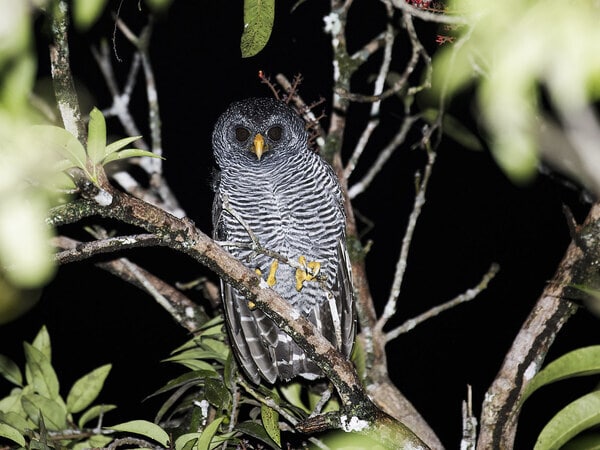
The Black-Banded Owl is not an owl that draws attention to itself. In the deep shade of tropical forests, its dark plumage allows it to blend into tree trunks and heavy foliage with ease. It is a medium sized owl, but its coloring makes it appear smaller and less distinct than it really is, especially in low light.
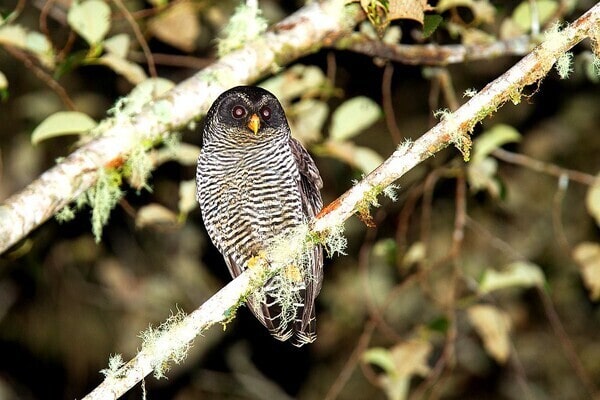
The feature behind its name is easiest to notice when the bird shifts position or when light reaches the chest and belly. Broad horizontal bands run across the underparts, darker than the background color of the feathers. These markings break up the owl’s outline and help it disappear against the layered textures of bark, vines, and shadow that dominate forest interiors.
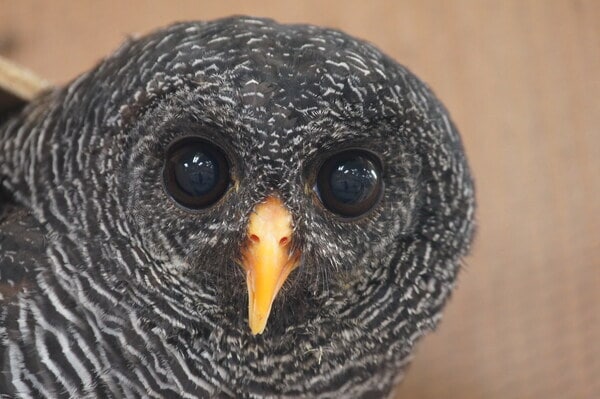
Its face follows the same restrained pattern. The facial disc is wide and dark, edged only faintly with lighter feathers. The eyes are also dark, lacking the bright or reflective quality seen in many owls that hunt in open habitats. When the bird is roosting during the day, the face does little to catch the eye, which is exactly what works in its favor.
Another clue to its identity comes from what is missing. The Black-Banded Owl has no ear tufts and no bold facial markings. Its body shape is compact and solid, typical of owls in the genus Strix, which are adapted for slow, silent movement through dense forest rather than fast flight over open ground.
In practice, the Black-Banded Owl is often identified without a clear view at all. Dense canopy limits visibility, and the bird spends most of its time hidden. Many records begin with a sound heard in the darkness rather than a shape seen in the branches. For this species, recognizing where you are and what kind of forest surrounds you can be just as important as seeing the bird itself.
How Scientists Classify the Black-Banded Owl
The Black-Banded Owl is placed within the genus Strix, a group of owls that share a similar build and way of life. These owls are typically medium to large in size, lack ear tufts, and depend heavily on hearing rather than vision alone when hunting. The scientific name of the Black-Banded Owl is Strix huhula, and it fits comfortably within this group based on both appearance and behavior.
For much of its scientific history, classification of this species has relied on careful observation rather than laboratory work. Ornithologists compared body shape, feather patterns, and especially vocalizations to determine where it belonged. The dark plumage and strong horizontal barring of the Black-Banded Owl match patterns seen in other forest dwelling Strix species, while its calls show clear differences from related owls that live in the same regions.
Scientific Classification
Sound has been particularly important in separating this owl from similar species. In dense tropical forests, visual identification is often unreliable, so researchers pay close attention to call structure, rhythm, and pitch. The vocal patterns of the Black-Banded Owl are consistent enough across its range to support its classification as a distinct species rather than a local form of another owl.
In recent years, genetic studies have been added to the taxonomic toolkit, helping confirm relationships within the Strix group. However, for the Black-Banded Owl, traditional features such as plumage, body proportions, and vocal behavior remain reliable and widely used. This reflects the fact that the species is well defined in the field, even if it is not often seen.
Variations Within the Species
Across its wide range, the Black-Banded Owl shows small but consistent regional differences. These differences are subtle, but they are stable enough that scientists recognize two subspecies rather than treating the species as completely uniform across South America.
The nominate subspecies, Strix huhula huhula, is found mostly in northern and central parts of South America. This includes large areas of the Amazon Basin, where forests are dense, humid, and continuously shaded. Birds from this region tend to show darker overall plumage, with heavier barring that blends well into the deep forest interior.
A second form, Strix huhula albomarginata, occurs farther south and east, mainly in southeastern Brazil, eastern Paraguay, and nearby parts of northeastern Argentina. In this part of the range, forests are still substantial but often differ in structure and seasonal conditions. Owls from these areas are generally described as slightly lighter, with less intense darkness in the plumage and clearer contrast along the feather edges.
These differences are not dramatic and would be difficult to notice without careful comparison. They involve gradual shifts in color tone, banding strength, and sometimes body size rather than clear visual markers. Importantly, there is no evidence that the two subspecies behave differently. Both follow the same nocturnal routines, hunt similar prey, and rely on intact forest for survival.
From a biological standpoint, these subspecies reflect long-term adaptation to regional environments rather than separation into distinct ecological roles. Wherever it occurs, the Black-Banded Owl remains a quiet forest specialist, shaped more by canopy cover and habitat quality than by geography alone.
Forest Types It Occupies
The Black-Banded Owl is closely tied to the interior of forests rather than their edges. It favors areas where the canopy remains largely unbroken and daylight rarely reaches the forest floor directly. In these conditions, shadow is constant, temperatures are stable, and movement can remain concealed. This owl is rarely associated with open landscapes and is generally absent from cleared land, plantations, or heavily disturbed forest margins.
Most records come from mature tropical and subtropical forests, particularly lowland rainforest and humid foothill forest. It can also occur in tall secondary forest, but only when the canopy has recovered enough to form a closed cover. The presence of large trees and layered vegetation appears to matter more than the specific tree species growing there.
Forest structure plays a central role in how the owl lives. Dense foliage provides safe roosting sites during the day, while the complexity of the understory supports a steady supply of prey. Small mammals, roosting birds, and large insects are more abundant in these intact habitats, allowing the owl to hunt efficiently without leaving cover.
Where forests are thinned, fragmented, or opened up, the Black-Banded Owl becomes increasingly scarce. Its dependence on shade and concealment makes it a poor candidate for adapting to altered landscapes. In this sense, the owl is not just a forest resident but a species shaped by forest depth and continuity.
Geographic Range
The Black-Banded Owl occupies a wide stretch of the Neotropics, but its presence is uneven and closely tied to remaining forest. It occurs from southern Mexico through much of Central America and extends deep into South America, including large portions of the Amazon Basin and neighboring forested regions.
Although this range looks extensive on paper, the species is not spread evenly across it. The owl tends to disappear from areas where forest has been broken into small fragments or removed entirely. As a result, its distribution follows the shape of intact woodland rather than political boundaries or latitude alone.
In South America, the Black-Banded Owl is most consistently found in forested areas east of the Andes, where broad tracts of tropical forest still exist. In Central America and southern Mexico, its presence becomes more localized, reflecting the patchier condition of forest habitat in those regions.
On range maps, large gaps often appear between occupied areas. These gaps do not indicate that the owl cannot survive there in principle. Instead, they reflect places where suitable forest no longer remains. In this way, the geographic range of the Black-Banded Owl serves as a quiet record of where continuous forest still survives across the Neotropics.
Activity Patterns and Hunting Behavior
The Black-Banded Owl is active almost entirely at night. As daylight fades, it begins to move within the forest, traveling beneath the canopy where darkness arrives early and lingers long after sunset. During the day, it remains hidden and inactive, relying on cover rather than flight to avoid detection.
Hunting is quiet and deliberate. Instead of chasing prey over long distances, the owl usually waits on a perch, listening intently before making a short, controlled flight. Once it locates a sound, it drops down with precision, using its talons to seize prey on the forest floor or in low vegetation. This method suits a habitat where space is tight and visibility is limited.
The owl’s diet is shaped by what the forest offers. Small mammals form an important part of its food, along with birds that roost at night and large insects active after dark. Rather than specializing in a single prey type, the Black-Banded Owl takes advantage of whatever is most available within its territory.
Like other owls in the genus Strix, it relies heavily on hearing. Its feathers are adapted for silent flight, allowing it to move through the forest without warning prey of its approach. Movements are measured and energy efficient, reflecting a hunting strategy designed for dense forest, where prey encounters may be infrequent and every opportunity matters.
Calls and Acoustic Identification
For most people who encounter the Black-Banded Owl, the experience begins with sound rather than sight. In dense forest, visibility is limited, but the owl’s voice can travel far through the trees. Its call is low and resonant, made up of deep hoots that carry well in still night air. These sounds often provide the only clue that the owl is present at all.
Vocal activity tends to increase during the breeding season, when individuals call more frequently and with greater consistency. At other times of the year, the owl may remain quiet for long stretches, sometimes passing nights without calling. This irregular pattern adds to the difficulty of detecting the species.
Because of this, researchers depend heavily on listening. Nighttime surveys focus on identifying calls rather than searching for movement, and recorded calls are sometimes used to prompt responses from owls in suitable habitat. Long term acoustic monitoring has also become an important tool, allowing scientists to confirm presence over time even when the birds are rarely seen.
Locating a Black-Banded Owl often requires patience more than skill. Observers may hear the same call night after night without ever seeing the bird itself. In forests where sound is often the most reliable source of information, the owl’s voice becomes its primary signature.
Breeding and Nesting Habits
The Black-Banded Owl follows a breeding strategy typical of many forest owls, relying on existing structures rather than building a nest of its own. Instead of constructing anything, it uses natural cavities in large, mature trees or takes advantage of abandoned nests left behind by other birds. These sites are usually well hidden and high above the forest floor, offering protection from predators and human disturbance.
Breeding timing is not fixed across the species’ range. In different regions, nesting activity appears to be linked to local environmental conditions, particularly rainfall patterns and prey availability. When food is more abundant, adults are better able to support the energy demands of raising young, which likely influences when breeding occurs.
What is known suggests that the Black-Banded Owl lays a relatively small clutch, consistent with other forest specialists that invest heavily in each offspring. Parental care extends well beyond hatching, with adults remaining attentive as the young develop and learn to survive within the forest environment.
Despite this, much of the species’ reproductive behavior remains poorly documented. Nests are difficult to locate, often concealed high within dense canopy where direct observation is challenging. As a result, many details of courtship, incubation, and early development are inferred from limited observations rather than continuous study. This lack of data reflects the owl’s secretive habits more than a lack of scientific interest.
Population Status and Conservation Concerns
The Black-Banded Owl is currently classified as Least Concern on the IUCN Red List, a designation based largely on its wide geographic range rather than on detailed population counts. This status indicates that the species is not facing an immediate risk of extinction at a global scale, but it does not mean that populations are stable everywhere the owl occurs.
Conservation Status
IUCN Red ListThe Black-Banded Owl is not currently considered at risk of extinction at a global level, although local populations may decline where forest habitat is lost.
The primary pressure facing the species is the loss of forest. As large areas of tropical woodland are cleared or broken into smaller fragments, suitable habitat becomes increasingly scarce. The Black-Banded Owl depends on mature forest with continuous canopy, and it does not adapt easily to open or heavily altered landscapes. When forest structure is disrupted, the owl often disappears without obvious signs of decline.
Where intact forest remains, the species can persist for long periods, even at low densities. In these areas, the owl continues to fill its role as a nocturnal predator, largely unnoticed. In contrast, regions that experience rapid deforestation or ongoing fragmentation tend to lose local populations, sometimes before their presence is well documented.
In this way, the conservation outlook for the Black-Banded Owl is closely tied to forest health rather than to the species’ biology alone. Its continued presence often reflects the survival of deep, undisturbed forest, making it a quiet indicator of ecosystem integrity across the Neotropics.
Why the Black-Banded Owl Is Rarely Observed
The Black-Banded Owl is rarely seen not because it is exceptionally rare, but because of how and where it lives. It prefers deep forest where human access is limited, becomes active only after dark, and often remains still and quiet for long periods. Even in areas where the species is present, it can go unnoticed for years.
Several factors combine to make detection difficult. Dense forest canopy limits visibility, especially during the day when the owl is roosting and relies on camouflage rather than movement. Its nocturnal lifestyle further reduces the chances of a visual encounter, as most of its activity occurs in near total darkness. In addition, the owl does not call continuously. Its vocalizations tend to be seasonal and irregular, which means long stretches may pass without any sound at all.
Key reasons sightings are uncommon include:
- Dense forest canopy that blocks clear lines of sight
- Nocturnal behavior with long periods of inactivity
- Limited and seasonal calling patterns
In practical terms, the Black-Banded Owl can be present in a forest without ever being noticed. It does not display itself, does not hunt in open areas, and does not call frequently enough to reveal its location. For many observers, the only evidence of its existence is a brief call heard in the distance, reminding them that some forest species are defined as much by their absence from view as by their presence.
Related Post
- Rufous Owl : A to Z Guide
- What Does A White Owl Mean : A to Z Explanation
- Do Owls Eat Birds : Let’s Understand Why
- Baby Great Horned Owl – A to Z Guide