
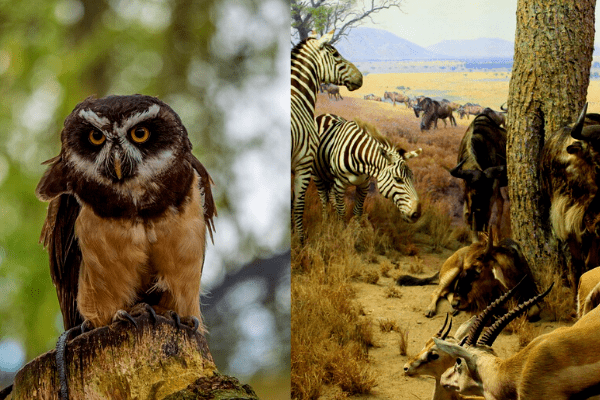
Owls are not mammals-they are birds, classified under the class Aves, order Strigiformes. Every defining biological feature of an owl feathers, egg-laying, hollow bones, beaks, wing structure, and avian-style thermoregulation places them firmly in the bird category.
However, many people still wonder if owls are mammals, and the confusion isn’t random. Owls behave, hunt, and move in ways that resemble mammalian predators like cats, foxes, or even small wild canines.
Why People Mistake Owls for Mammals: The Psychology Behind the Confusion
People often misidentify animals when the brain relies on behavioral similarity instead of biological traits a pattern supported by research in animal perception and cognitive psychology. Owls trigger this confusion because:
They behave like nighttime mammal predators
Owls hunt silently, stalk prey, and ambush in the dark exactly how nocturnal mammals like cats or foxes hunt. This creates a subconscious association.
They show “face-forward” vision like mammals
Most birds have eyes on the sides of their heads. Owls don’t. Their binocular forward-facing vision resembles mammalian predators (cats, primates), tricking people into thinking they’re mammal-like.
They display intelligent, expressive behavior
Owls tilt their heads, react to sound direction, and observe movement with focus behaviors humans instinctively associate with smart mammals.
They are warm-blooded
Many people wrongly assume “warm-blooded = mammal.”
But birds are also warm-blooded known as avian endotherms a completely different biological system from mammals.
In reality, owls lack every core mammalian trait: fur, live birth, mammary glands, three middle-ear bones, and specialized teeth. The similarities are behavioral not biological.
Owl Intelligence vs. Mammal Intelligence: Why People Get Misled
Owls are often compared to intelligent mammals because of their calm, observant behavior. But scientific studies on avian cognition show:
Owls are intelligent-but not in the same way as mammals
Owls rely more on instinct, sensory precision, and spatial memory than problem-solving or tool use (which mammals like primates or dolphins excel in).
Their focused gaze creates an illusion of thinking
Owls can’t move their eyes sideways due to fixed eye tubes.
So they rotate their heads up to 270 degrees to track movement.
This head-turning behavior looks “thoughtful,” similar to how mammals analyze their surroundings.
Silent hunting mimics feline stealth
Their feather structure absorbs sound, allowing them to fly silently similar to how cats approach prey quietly. This creates the impression of “mammal-like intelligence,” but it’s simply specialized avian anatomy.
Owls are smart predators, but their intelligence evolved differently and is rooted in bird physiology, not mammalian brain structure.
Real-World Science Examples: How Biologists Officially Classify an Owl
To avoid confusion, biologists rely on objective anatomical and reproductive evidence, not behavior.
Every owl, from barn owls to great horned owls, fits perfectly into the class Aves based on universally recognized scientific criteria.
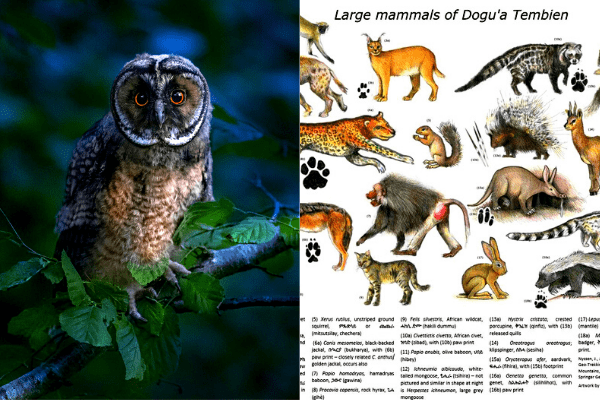
The Taxonomic Checklist Scientists Use to Confirm an Owl Is a Bird (Aves)
When biologists classify an owl, they don’t rely on how it behaves or hunts. They look for anatomical and reproductive traits that are universally used in zoology to separate birds (Aves) from mammals. Owls meet every defining requirement of a bird, starting with their feathered bodies and beaked skulls. These traits are not optional no mammal on Earth has feathers, lays hard-shelled eggs, or possesses a skeletal structure adapted for flight in the same way birds do.
To confirm an owl’s identity as a bird, scientists typically check for the following features:
Feathers, the single most important characteristic of the Aves class.
A toothless keratin beak, instead of mammalian jaws and teeth.
Egg-laying reproduction, where females lay hard-shelled eggs.
A lightweight skeleton, including hollow or semi-hollow bones designed for flight.
Wings formed from modified forelimbs, a structural trait mammals lack.
An avian respiratory system with air sacs that mammals do not possess.
Together, these characteristics form a clear, evidence-backed checklist that places owls firmly within the bird class, helping answer the question Are Owls Raptors, no matter how mammal-like their behavior may sometimes appear.
Field Methods Experts Use to Distinguish Owls From Mammalian Predators in the Wild
Wildlife biologists use field techniques that clearly differentiate owls from mammals even when observing behavior:
1. Vocalization Analysis
Owls produce species-specific hoots or screeches generated by avian syrinx structures. Mammals use larynx-based vocal cords acoustically different.
2. Feather Evidence
Feather fragments, preening marks, and wing prints are unmistakable indicators of bird identity.
No mammal leaves feather traces.
3. Nesting and Egg Sites
Owls create nests or roosts where they lay eggs a definitive bird trait. Mammalian predators never leave eggs behind.
4. Skull and Bone Identification
Owls have lightweight skulls with a beak; mammals have heavy jaws with tooth sockets.
Field researchers often classify remains using this key difference.
5. Hunting Signatures
Owls swallow prey whole and leave behind pellets (regurgitated bones and fur).
This pellet formation is a unique avian digestion trait not seen in mammals.
All these methods make it scientifically impossible to classify owls as mammals.
If you want to read it detail – Click Here
Related Post