
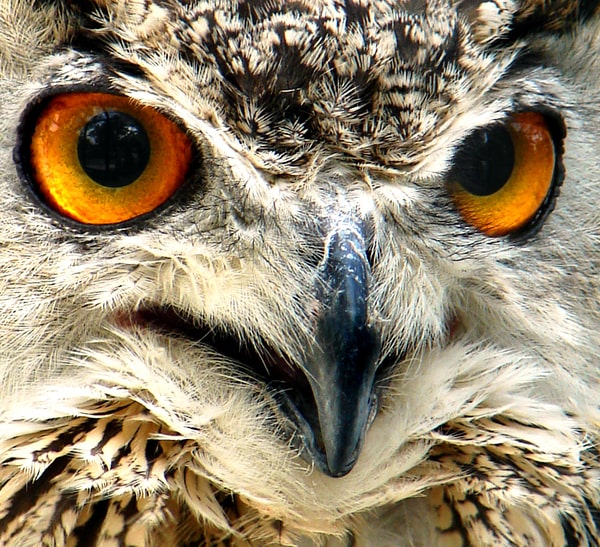
An owl’s face is one of nature’s most efficient sensory tools, even though most of us first notice it simply because it looks so unusual. The flat shape, forward-facing eyes, and neat ring of feathers aren’t ornamental; they form a system that helps the owl see and hear with remarkable accuracy.
Many species develop a rounded facial disc, which biologists often compare to an acoustic dish because it funnels sound straight toward the owl’s ears. This design is so effective that some owls can locate prey purely by sound, even in complete darkness.
Their eyes, fixed in their sockets, give owls strong depth perception but limited side vision, which is why the birds rely on wide head rotation instead of eye movement. The beak, tucked high and close to the face, ensures nothing blocks their forward view-crucial when hunting at night.
What makes the owl face even more intriguing is how humans react to it. The symmetry and large binocular eyes feel oddly familiar, almost expressive, even though owls don’t display facial emotions. This mix of evolutionary precision and accidental charm makes the owl face unforgettable.
Functional Shape of the Owl Face
The shape of an owl’s face may look simple at first glance, but it is one of the most refined sensory designs in the bird world. Owls have noticeably flatter faces than most species, and this isn’t just a quirk of appearance. A flatter front helps sound and light reach the eyes and ears without anything getting in the way. In many owl species, the feathers around the face form a shallow bowl known as the facial disc.
Researchers studying barn owls and great gray owls have shown that this disc works a bit like a sound-catching dish, directing even faint rustles toward the ear openings tucked beneath the feathers. When the feathers shift slightly, the way sound is collected shifts too, giving the owl remarkable control over how it listens.
Another subtle but important feature is the position of the beak. Instead of jutting forward like in hawks or crows, an owl’s beak sits high and close to its face. This keeps the beak from blocking the owl’s forward view, which is essential when relying so heavily on depth perception and low-light vision.
Every part of the face is arranged to keep its sensory pathways clear and efficient, turning what looks like a calm expression into a finely tuned system built for precision in the dark.
The Owl Face Diagram: What Each Part Does
If you look closely at a labeled owl face, the first thing you notice is that nothing on it is just for decoration. Every tuft, feather and oddly shaped patch has a specific job. The facial disc, that rounded frame of feathers, works like a built-in acoustic collector. By adjusting these feathers, owls can change how sound is directed toward their ears, which helps them detect even the faintest movements. The ear openings, usually hidden beneath feathers, often sit at slightly different heights in many species. That tiny asymmetry lets owls judge whether a sound is coming from above or below with impressive accuracy.
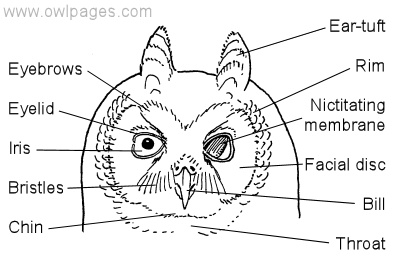
The eyes in the diagram look familiar, but their structure is very different from ours. Owl eyes are elongated tubes packed with light-sensitive cells, which is why they perform so well in low light. A bony brow ridge sits above them for protection. The small cere at the base of the beak contains sensory nerves that help the owl track airflow, and the bristle-like feathers near the beak act almost like tactile feelers when prey is close.
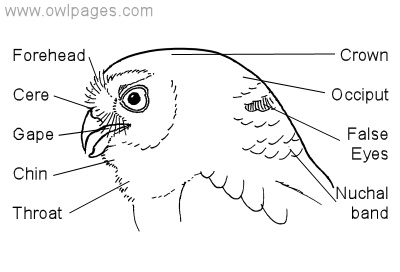
All together, the diagram reveals a face built not for expression but for precision. Every feature contributes to how an owl senses the world around it.
Thanks to OwlPages for the diagram.
Eye Position and Visual Field
One of the most striking things about an owl’s face is the way its eyes sit side by side, both pointed forward. Very few birds have this kind of arrangement, and it gives owls something precious in the dark: true binocular vision. With both eyes sharing a large overlap in their fields of view, an owl can judge distance with impressive accuracy. This is a major advantage when you hunt by dropping onto prey that may only appear as a slight movement in the grass.
Their eyes, however, come with one interesting limitation. Because they are elongated tubes rather than round, flexible spheres, owls cannot roll their eyes the way humans do. Instead, they rely on a neck built for movement. With fourteen cervical vertebrae, far more than we have, they can swing their head around in wide arcs that look almost impossible. This compensates for the narrow side vision created by the forward-facing design.
What owls lose in peripheral view, they make up for in sensitivity. Their large lenses and high concentration of rod cells allow them to collect every scrap of available light. Combined with their unwavering forward focus, this gives them a steady, finely tuned view of the world that is perfectly suited to silent, accurate hunting at night.
Human Perception of Owl Faces
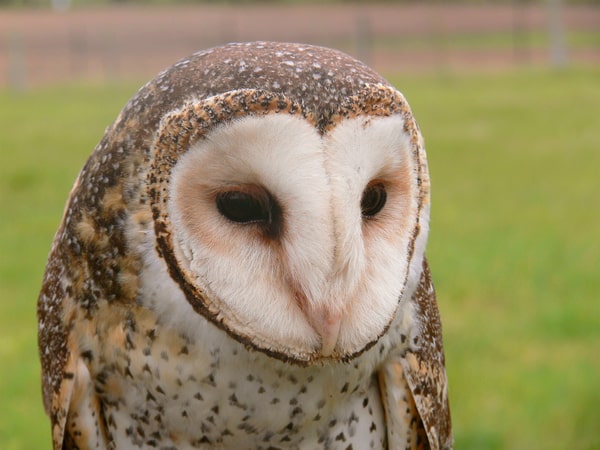
For all the scientific precision behind an owl’s face, humans often respond to it in a completely different way. We look at those big, forward-facing eyes and that tidy ring of feathers, and our brains immediately try to read an expression. It is a funny mismatch, because owls cannot raise an eyebrow, smirk, frown or do anything that remotely resembles a human expression.
Yet people still insist an owl looks wise, annoyed, judging, or vaguely disappointed in our life choices. This is simply our old friend pareidolia at work, the tendency to project familiar features onto things that do not actually have them.
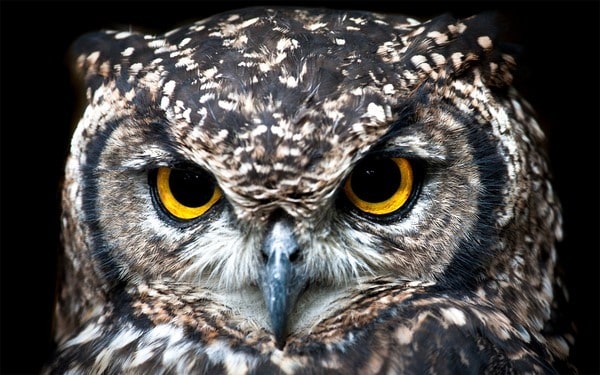
The symmetry of an owl’s face plays a strong role in this. We naturally pay attention to anything that resembles a human facial layout, and owls accidentally fit that template surprisingly well. Their steady, unblinking stare only makes it more convincing, which is a major reason why owl looks sad to human observers. What to the owl is just a normal way of looking at the world becomes, to us, a gaze filled with meaning.
Cultures around the world picked up on this long before scientists explained it. Owls have been symbols of wisdom, mystery and sometimes mischief, largely because their faces seem to carry a personality.
In reality, it is simply a bird whose features evolved for hunting in the dark, not for looking thoughtful. Still, it is hard to shake the feeling that an owl knows something we don’t, even if it is just the location of the nearest mouse.
Related Post
- Can Owls Move Their Eyes – Read The Answer
- Do Owls Blink – Lets Understand The Science Behind It
- Owl Beak : A to Z Guide
- Owl Ears : Everything You Need To Know
- The A – Z Guide Of Owl Legs