
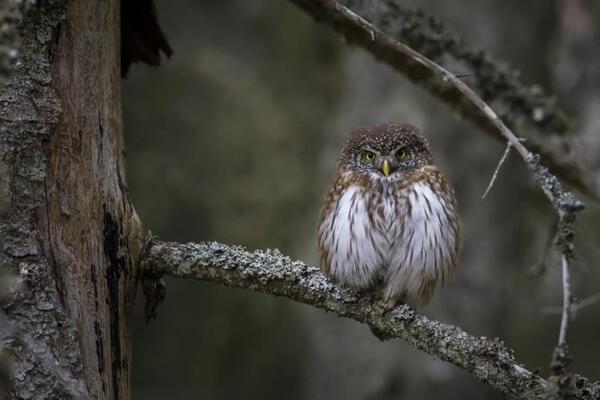
It’s easy to overlook a pygmy owl because of its size, but these tiny raptors behave nothing like the gentle fluff balls they resemble. In many forests, they’re the boldest hunters around-darting through branches in broad daylight, snatching songbirds and small mammals with a speed that larger owls simply can’t match. Researchers have documented pygmy owls hauling prey that makes up more than half their own weight, an astonishing lift for a bird this small.
Look closely at one and you’ll notice the two dark “eyespots” on the back of the head. They aren’t decoration. These markings help deter predators that try to sneak up behind the owl while it sits exposed on open perches. And unlike most owls, pygmy owls prepare for lean times by caching extra prey in tree cavities and branch forks-a practical habit that often reveals where they’ve been hunting.
Their lives are tightly tied to healthy forests, especially areas with woodpecker-made cavities for nesting. Yet even with their confidence, they face serious threats from larger owls, hawks, and ground predators. As climate shifts reshape forests and snowpack patterns, some pygmy owl populations are already adjusting where they live, showing just how sensitive these small hunters are to environmental change.
Characteristic Profile of the Pygmy Owl
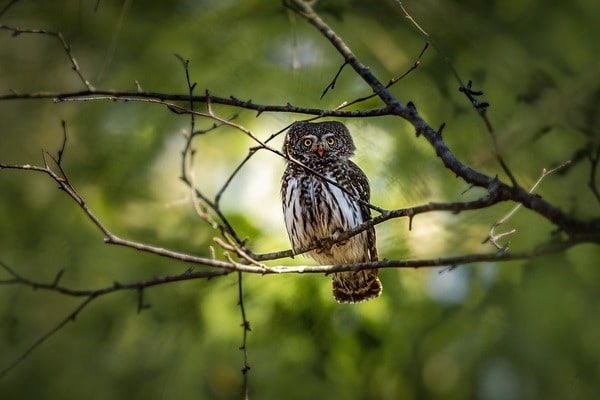
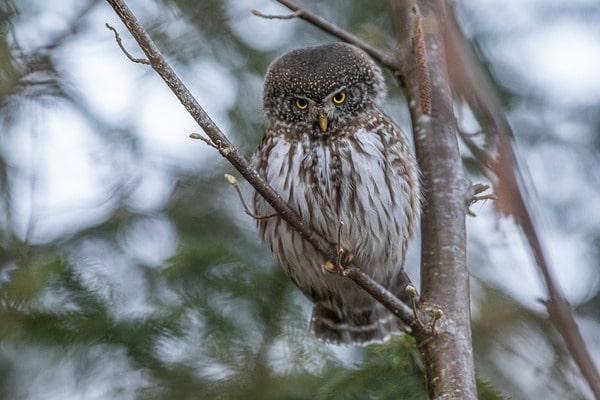
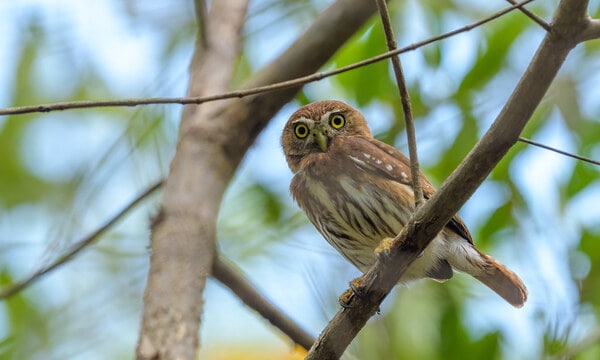
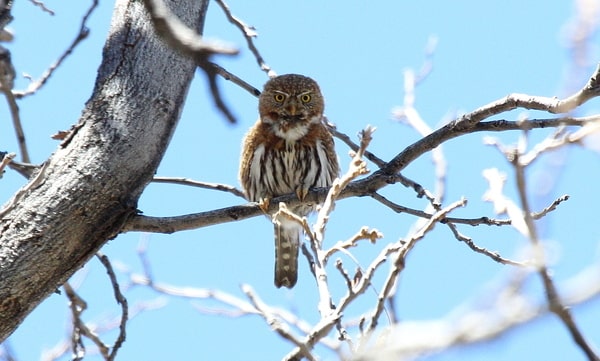
A pygmy owl may look delicate at first glance, but a closer look reveals a compact, athletic bird built for fast hunting. Their body shape is tight and muscular with a long tail that acts like a steering rudder when they weave through branches. Their eyes are bright yellow, their facial disc is narrow, and their posture is capped by that upright, alert look that makes them seem ready to launch at any moment. Unlike larger owls that rely heavily on sound, pygmy owls depend more on sharp vision, which is part of what makes them confident daytime hunters.
Key identifying features include
• Small body size typically around fifteen to eighteen centimeters
• Long narrow tail for quick maneuvering
• Bright yellow eyes with strong depth perception
• Barred or spotted plumage that blends into conifer forests
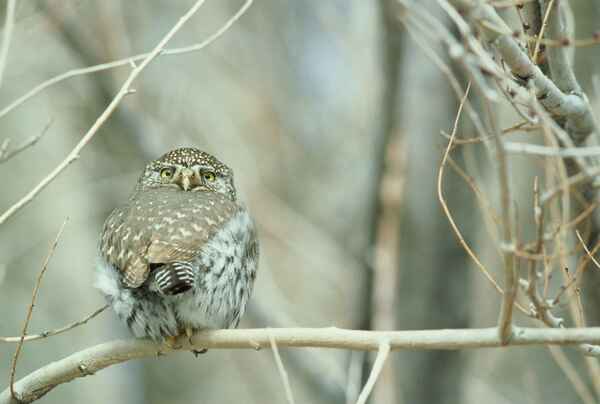
• Distinct eyespots on the back of the head
The Advantage of Being Small
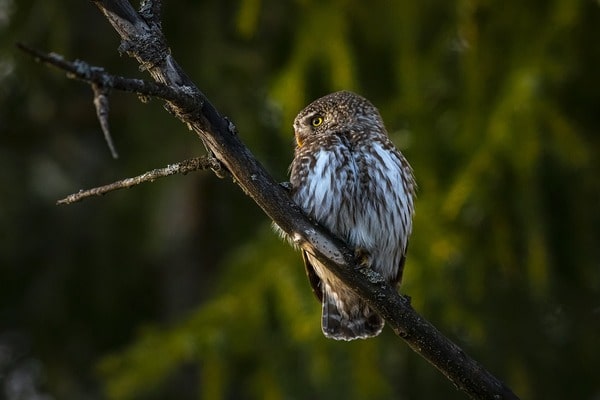
Being small gives pygmy owls access to hunting strategies that bigger owls cannot use. They slip between branches with ease, sit on narrow exposed perches that provide full visibility, and launch lightning fast ambushes at birds that would easily escape a heavier raptor.
Their size also means they burn energy quickly which pushes them to hunt often, giving them more chances to refine their technique. In dense forests where visibility is broken and space is tight, the pygmy owl’s small form becomes a true advantage rather than a limitation.
Their Eyespots Explained
Look at the back of a pygmy owl’s head and it appears to have an extra pair of eyes. These dark circular markings are an anti predator adaptation that scientists have documented across several members of the genus Glaucidium.
While the owl faces forward scanning for prey, the eyespots create the illusion that it is watching in the opposite direction. This reduces the risk of ambush from hawks, mustelids, or even aggressive mobbing birds.
Eyespots are not decorative or random; they are a deliberate survival feature that helps a small owl stay alive in a forest full of larger hunters.
Daylight Hunting Explained
Most owls save their energy for the night, but pygmy owls operate when the forest is bright and active. Their vision works well in daylight and allows them to track quick movements like the flutter of a songbird or the dart of a vole.
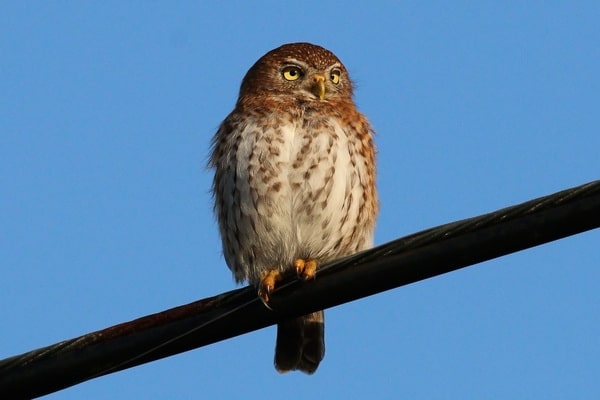
They often hunt from low exposed perches where they can watch the understory and listen for rustling. Their strategy is simple but effective: wait, focus, and launch straight toward the target with a burst of speed.
This daytime approach gives them access to prey that nocturnal owls rarely catch and reduces competition.
Their Prey Storage Behavior
Pygmy owls are practical hunters who prepare for shortages by storing extra kills. This behavior has been widely documented in both North American and Eurasian species. They wedge prey into natural cavities, crevices, or even dense clusters of needles, returning later when hunting conditions are poor. During winter or when feeding young, these hidden reserves become especially valuable.
Reasons they store prey
• To maintain reserves during cold or low prey periods
• To reduce the need for frequent hunting during nesting
• To take advantage of sudden prey abundance
• To secure food from scavengers
Forest Dependence and Territory Patterns
Pygmy owls are strongly tied to mature forest ecosystems. They rely on natural cavities for nesting and shelter, many of which are created by woodpeckers. Their preferred territories contain a combination of tall perches, dense hunting zones, and open sightlines for chasing small birds. Territory size varies with prey availability, but pygmy owls generally defend compact areas that provide steady food sources.
Important forest features for pygmy owls
• Standing dead trees that provide nest cavities
• Mixed or conifer dominated forests with layered vegetation
• Abundant small birds and small mammals in the understory
• Safe perches with good visibility
Who Preys on Pygmy Owls
Even though they are fierce hunters, pygmy owls remain vulnerable to larger predators. Raptors that specialize in quick pursuit flights can catch them in exposed moments, and nocturnal owls may take them when they are resting.
Ground predators can also ambush them near nesting cavities or while they are caching prey.
Main predators include
• Larger owls such as Great Horned or Ural Owls depending on the region
• Accipiter hawks that excel at fast pursuit
• Martens and weasels
• Opportunistic mammals including foxes
How Pygmy Owls Communicate
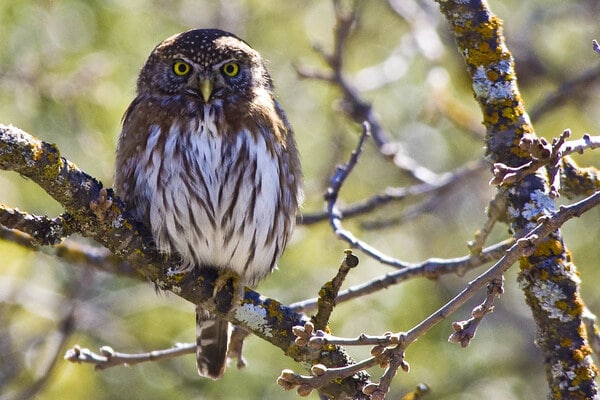
Pygmy owl communication is simple but distinct. Their territorial call often resembles a series of evenly spaced whistles that carry through forest habitats. Males call frequently during the breeding season, using their voice to signal ownership of territory and to attract a mate.
Their calls also help pairs stay connected as they move through dense vegetation. Because their territories are small, vocal communication plays a practical role in spacing and social structure.
Climate Change and Their Range
Changes in temperature and forest structure are already influencing where pygmy owls can live. Studies in multiple regions show movements toward higher elevations and shifts in northern boundaries as habitats warm. Snowpack changes affect prey cycles and cavity availability which in turn impact breeding success. Forest loss from fires, logging, or shifting vegetation patterns may further narrow suitable habitat.
As a forest dependent predator with specific nesting needs, the pygmy owl is closely tied to the stability of its environment. Climate pressure highlights how sensitive this species is to even subtle ecological changes.
Related Post
- Rufous Owl : A to Z Guide
- What Does A White Owl Mean : A to Z Explanation
- Do Owls Eat Birds : Let’s Understand Why
- Baby Great Horned Owl – A to Z Guide