
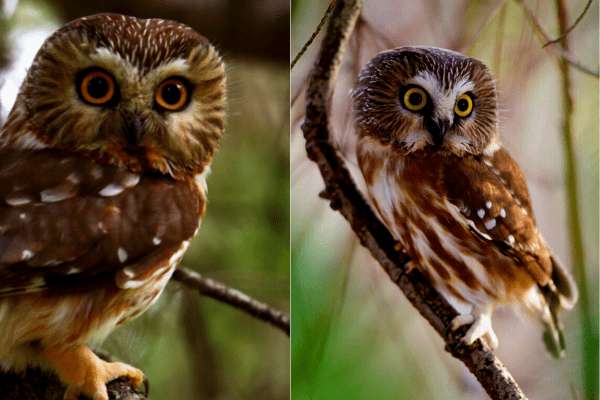
The Northern Saw-whet Owl (Aegolius acadicus) is one of the smallest owls in North America, yet it occupies a surprisingly large range, stretching from southern Canada through much of the United States. Most people never see one, not because the owl is rare, but because it lives quietly. It hunts only at night, roosts deep in foliage during the day, and often goes unnoticed even in well-studied forests. Its name comes from a sharp, rhythmic call that resembles the sound of a saw being sharpened, a call more commonly heard than the bird itself.
This owl feeds mainly on small mammals, especially mice and voles, and depends on healthy forest structure for both prey and shelter. Long-term banding studies have shown that many Northern Saw-whet Owls migrate seasonally, sometimes traveling great distances despite their small size. Well adapted to cold climates, they survive winter through dense insulation, efficient hunting, and prey storage. Widespread but rarely observed, the Northern Saw-whet Owl is a quiet reminder of how much wildlife remains hidden in plain sight.
Species Status and Classification
The Northern Saw-whet Owl is formally classified as Aegolius acadicus, a small owl within the family Strigidae, which includes most of the world’s typical owls. Ornithologists place it in the genus Aegolius alongside a few other compact, forest-dwelling species that share similar body proportions, vocal patterns, and adaptations to cooler climates.
This classification is based on long-standing morphological study, vocal behavior, and geographic consistency rather than recent taxonomic revision, and it has remained stable in scientific literature for many decades.
The species’ unusual common name comes from early observers who likened its repetitive call to the sound of a whetstone sharpening a saw, a comparison recorded in historical natural history accounts rather than folklore. Unlike several owl species whose classification has been revised through genetic reanalysis or species splitting, Aegolius acadicus has shown clear continuity across its range.
Its size, plumage structure, and vocal characteristics remain consistent enough that researchers have not questioned its status as a single, well-defined species, making it one of the more taxonomically settled small owls in North America.
Population-Level Variation
Across its broad North American range, the Northern Saw-whet Owl shows small but consistent differences between regional populations. These variations are most noticeable in overall body size and plumage tone rather than in skeletal structure or proportions.
Owls from northern latitudes and coastal forests tend to be slightly larger and darker, while individuals from more southern parts of the range are often lighter in color and marginally smaller. Such patterns are common among forest birds and are generally linked to climate, prey availability, and habitat conditions rather than to sharp genetic separation.
Researchers recognize two primary forms:
- Aegolius acadicus acadicus – widespread across most of North America
- Aegolius acadicus brooksi – restricted to Haida Gwaii (Queen Charlotte Islands), British Columbia
These population-level differences reflect long-term environmental influence and limited gene flow rather than recent evolutionary change, and they do not obscure the species’ overall biological unity.
Morphology and Size
The Northern Saw-whet Owl is among the smallest owl species found in North America, and its physical form reflects a life spent moving through tight forest spaces rather than open air. Its body is compact, with short, rounded wings that allow for quiet, controlled flight between branches.
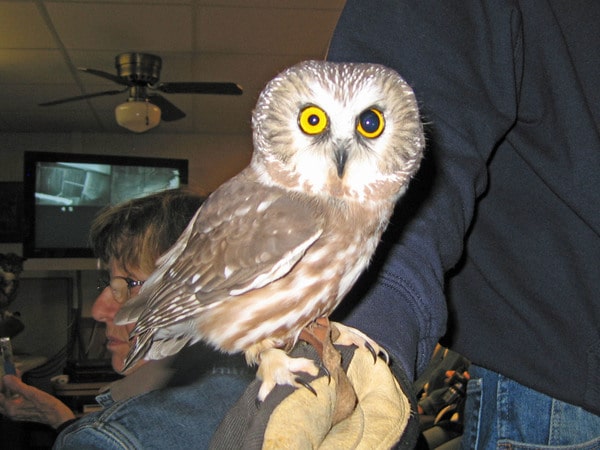
The head is rounded and lacks ear tufts, giving the owl a smooth outline that blends easily into tree trunks and dense foliage. A prominent facial disc surrounds the eyes and beak, helping direct sound toward the ears and improving its ability to locate prey in low light.
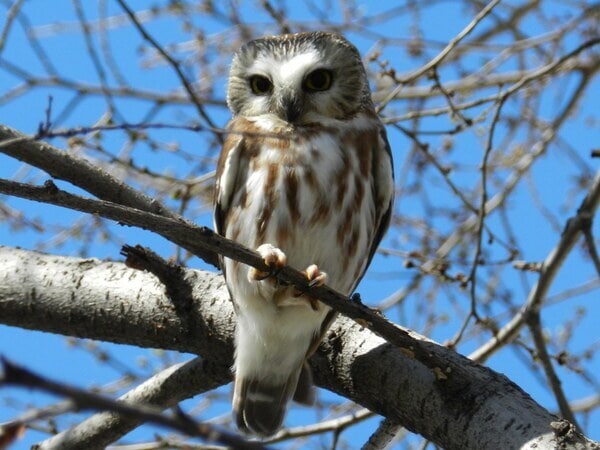
In terms of size, adults typically measure between eighteen and twenty-one centimeters in length, with a wingspan that ranges from roughly forty-five to fifty-six centimeters. Body weight usually falls between sixty-five and one hundred ten grams, depending on sex, season, and local conditions.
The plumage is predominantly brown with pale spotting on the upperparts and a lighter, streaked underside, providing effective camouflage during daytime roosting. Females are consistently larger than males, a difference that becomes most noticeable during breeding and prey handling and follows a pattern seen across many owl species.
Geographic Range and Habitat Use
The Northern Saw-whet Owl is distributed across a large portion of North America, occurring from southern Canada through much of the northern and central United States. Its presence spans both eastern and western regions, including forested lowlands, mountain ranges, and mixed woodland systems.
During the breeding season, the species shows a strong association with mature forests, particularly areas where coniferous and deciduous trees occur together. These habitats provide the combination of cover, prey availability, and natural cavities that the owl depends on for nesting.
Outside the breeding period, habitat use becomes noticeably more flexible. Individuals may be found in dense woodlands, thick shrub cover, forest edges, and occasionally in well-vegetated suburban areas where suitable shelter and prey are available.
Evidence from bird banding programs has shown that many Northern Saw-whet Owls shift location seasonally rather than remaining in one forest type throughout the year. These movements appear to be driven by changes in prey abundance and the availability of secure roosting sites, allowing the species to persist across a wide range of environmental conditions.
Vocal Behavior
Sound is one of the primary ways the Northern Saw-whet Owl communicates, especially during the breeding season when visual contact between individuals is limited.
The call most often associated with the species is a high, clear note repeated at a steady rhythm, sometimes for long stretches of time from a concealed perch. Because the owl is small and usually hidden by vegetation, this call is often the first and only sign of its presence in an area.
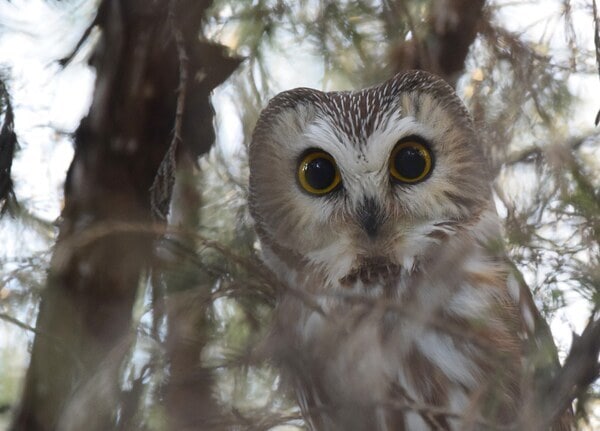
This repetitive vocalization serves several functions. It allows males to advertise their presence to potential mates, define occupied space, and reduce direct conflict with neighboring individuals by maintaining clear acoustic boundaries.
Females and young birds also vocalize, but their sounds tend to be softer and less regular, and they are rarely heard unless an observer is very close. Once the breeding season ends, calling activity declines sharply, and the owl becomes largely silent. This seasonal shift in vocal behavior plays a major role in why the Northern Saw-whet Owl is so difficult to detect outside of spring and early summer.
Activity and Ecology
If you were trying to find a Northern Saw-whet Owl during the day, you would likely walk past it without ever realizing it was there. These owls are active almost entirely at night and usually leave their roosts shortly after sunset. Once daylight returns, they settle into dense foliage or press close to tree trunks, remaining motionless for hours.
Their small size and mottled coloring allow them to disappear into shadow and bark, which is why the species often goes unnoticed even in forests where it is fairly common.
Ecologically, the Northern Saw-whet Owl lives a quiet, focused life as a small nocturnal predator. It hunts mainly small mammals and does so with patience rather than speed, relying on stillness and precise movements instead of constant flight.
By feeding on rodents, it plays a modest but steady role in keeping local prey populations in balance. Its need for cover, prey, and suitable nesting sites also ties it closely to forest conditions. When these elements are present, the owl can persist with remarkable efficiency, even in landscapes where food availability shifts from night to night.
Feeding Ecology
Most of what we know about the Northern Saw-whet Owl’s diet comes from the study of pellets collected beneath roosts and nesting sites. These pellets give a clear picture of what the owl has been catching over time, and they tell a consistent story. Across much of its range, the Northern Saw-whet Owl feeds mainly on small mammals.
Mice and voles appear again and again in diet studies, not only because they are abundant in forest habitats, but because they are the right size for a small owl that hunts by waiting and listening rather than chasing prey over long distances.
That said, the species is not rigid in its feeding habits. When rodents become scarce, the owl adjusts. Shrews, small birds, and even large insects can become part of the diet, particularly during certain seasons or in specific habitats.
This ability to switch prey helps explain why the Northern Saw-whet Owl can live in a wide range of forested environments. Its feeding behavior is guided less by strict specialization and more by what is locally available, allowing it to cope with natural rises and falls in prey populations.
Winter Survival Strategies
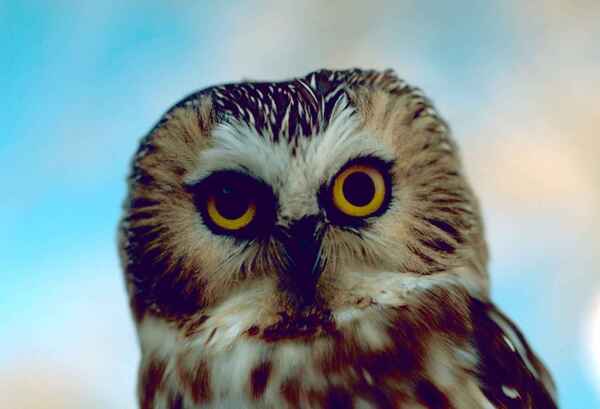
Winter poses a serious challenge for a small owl, yet the Northern Saw-whet Owl remains active throughout the cold months across much of its range. Its survival depends on a combination of physical traits and carefully timed behaviors rather than on any single adaptation.
Dense plumage provides effective insulation, trapping body heat and reducing energy loss during long winter nights. During daylight hours, the owl limits movement and selects sheltered roost sites that reduce exposure to wind and extreme cold.
Behavioral flexibility also plays an important role. When prey is abundant, individuals have been observed storing food and returning to cached prey during periods when hunting becomes difficult. This ability to balance energy intake and expenditure allows the owl to remain active even during extended cold spells.
Together, these strategies help maintain body temperature and overall condition, enabling the Northern Saw-whet Owl to persist in environments that are challenging for many birds of similar size.
Conservation Status
Across North America, the Northern Saw-whet Owl is currently listed as a species of Least Concern. This classification reflects its wide range and the fact that, at a continental scale, there is no clear evidence of a rapid or widespread decline. However, this label can be misleading if taken at face value.
Being difficult to see does not mean a species is doing well, and for an owl that spends most of its life hidden in dense cover, population changes are easy to miss.
The main pressures facing the Northern Saw-whet Owl are tied to changes in forest structure rather than direct persecution. The loss of mature forests, especially those with standing dead trees and natural cavities, can quietly reduce suitable nesting and roosting sites. In fragmented landscapes, populations may persist but become more isolated and vulnerable over time.
Because of these challenges, long-term monitoring has become essential. Banding programs and coordinated research efforts have revealed migration patterns, survival rates, and local declines that would otherwise go unnoticed, helping scientists build a more accurate picture of how this small owl is really faring.
Related Post
- Rufous Owl : A to Z Guide
- What Does A White Owl Mean : A to Z Explanation
- Do Owls Eat Birds : Let’s Understand Why
- Baby Great Horned Owl – A to Z Guide