
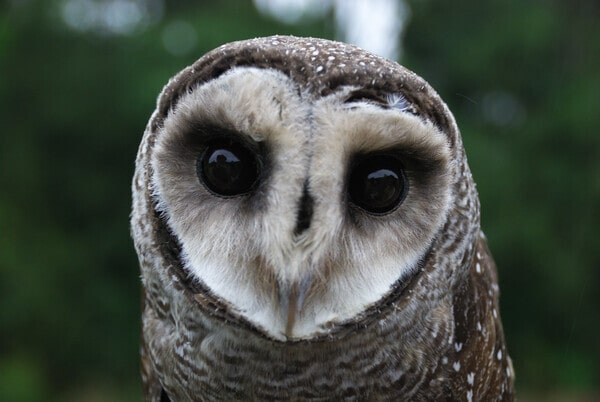
The Greater Sooty Owl is a dark, medium-to-large forest owl found in south-eastern Australia and parts of New Guinea. It stands out for its charcoal-grey plumage, rounded facial disk and unusually large talons, all of which help it hunt effectively in dense, wet forests and steep gullies. One of its most recognizable traits is its long, descending “bomb-whistle” call-a sound often heard before the owl itself is ever seen.
This species is a quiet, nocturnal predator that feeds mainly on small to medium-sized mammals, especially gliders, possums and various rodents. In ecosystems where these are scarce, it may also take birds, insects or bats. Its ability to adapt its diet based on local prey makes it more resilient than many forest-specialist owls.
Although listed globally as Least Concern, the Greater Sooty Owl faces local pressures from habitat loss, old-growth forest decline and reduced nesting hollows. Some Australian regions consider it vulnerable, emphasizing the importance of conserving mature forests and maintaining connected habitat corridors for its long-term survival.
Greater Sooty Owl: Size, Features and Dark Appearance
The Greater Sooty Owl (Tyto tenebricosa) is one of Australia’s most visually striking forest owls. Its dark charcoal to soot-grey plumage is peppered with fine pale spots, giving it a shadow-like appearance as it moves through wet forests at night. Adults typically measure 37–52 cm in length, with wingspans reaching up to 112 cm, making it one of the larger members of the Tyto family. The rounded, pale-edged facial disc helps direct sound into the ears, a key advantage when hunting in dense vegetation where sight is limited.
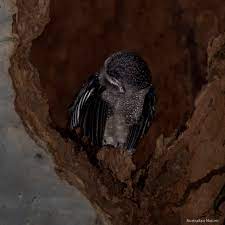
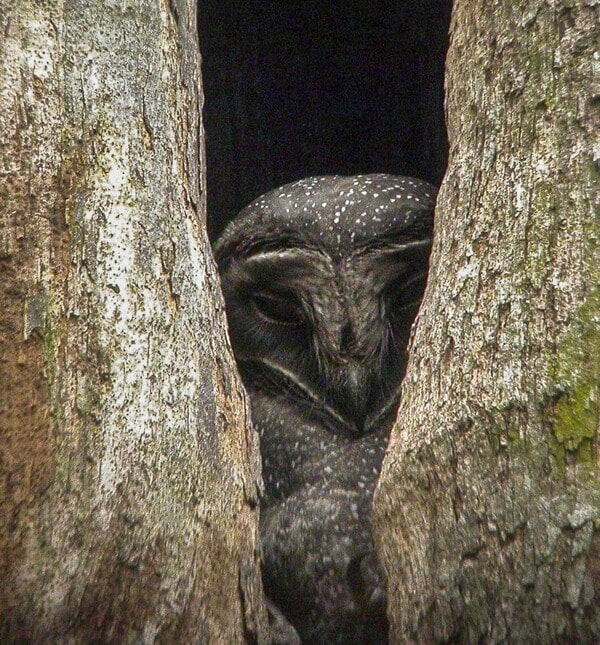
Its powerful legs and oversized talons are built for grabbing agile prey such as gliders and possums, while its flight feathers are adapted for near-silent movement. The owl’s “sooty” colouring and deep black eyes make it blend seamlessly into tree hollows and dark forest understories a major reason it is so rarely seen despite being widespread in suitable habitat.
Key features:
- Length: 37–52 cm
- Weight: generally 750–1250 g
- Dark, finely speckled plumage
- Very large talons for its size
- Near-silent flight feathers
- Deep, rounded facial disc for sound direction
Greater Sooty Owl Mystery: Habitat, Voice and Life Cycle
Much of the species’ mystery comes from where it chooses to live. Greater Sooty Owls occupy wet sclerophyll forests, rainforest edges, deep gullies and old-growth timber stands across south-eastern Australia and parts of New Guinea. These habitats are dense, steep and often inaccessible, making the owl difficult to study. Their range strongly overlaps with areas rich in hollow-bearing trees, which they depend on for nesting and daytime roosting.
Its eerie, descending screech often compared to a “falling bomb whistle” carries far across valleys at night. This call functions as both territory advertisement and contact communication, yet it is so distinctive that many who hear it assume it belongs to a much larger animal.
Their life cycle also contributes to their secretive reputation. Sooty Owls mate for extended periods and raise one or occasionally two chicks inside large hollows high above the forest floor. Because these hollows are hidden, breeding activity often goes unnoticed even by people working in the area.
Why they’re so elusive:
- Prefer steep, densely vegetated forests
- Roost high inside deep hollows
- Mostly active late at night
- Their dark plumage prevents easy detection
- Their calls give them away, but sightings are uncommon
The Greater Sooty Owl’s Diet and Night Hunting Style
The Greater Sooty Owl feeds in a way that matches its personality: quiet, deliberate and incredibly efficient. Most of what we know comes from long-term pellet studies across Victoria, New South Wales and Queensland, all of which show the same pattern this owl depends heavily on the mammals that share its wet forest habitat. Gliders and possums make up much of its nightly menu, especially arboreal species that move along branches and gliding paths. Rodents also feature regularly, with native rats preferred but introduced species taken when they’re abundant.
What makes the Sooty Owl interesting is how it adjusts when conditions change. After major bushfires or in forests where small mammals decline, researchers have documented a clear dietary shift. The owl begins supplementing with bats, birds, large insects and occasionally small reptiles. This ability to switch targets is likely one of the reasons the species persists across different forest structures and elevations.
Unlike faster, open-country raptors, the Sooty Owl hunts in a slow, low and almost soundless style, using its exceptional hearing to pinpoint prey rustling through the understory. In the dense forests it lives in, sound often matters more than sight, and that gives this species a major advantage.
Diet highlights:
- Primarily small to medium mammals
- Highly adaptable depending on habitat and prey availability
- Hunts from perches or in slow, silent flight
- Relies heavily on sound to detect prey in thick vegetation
Greater Sooty Owl Facts: Behaviours and Adaptations to Know
For a species that rarely shows itself, the Greater Sooty Owl leaves behind a surprising amount of evidence about how it lives. Much of what scientists know comes not from sightings, but from the owl’s patterns its roost remains, its pellets, its calls echoing through valleys, and the types of hollows it revisits year after year.
These owls usually hunt alone and move through large territories, often following natural forest corridors like ridgelines and deep gullies. They tend to return to the same daytime roosts, which makes these spots valuable to researchers studying long-term diet trends. The pellets they leave behind give highly reliable clues about local mammal populations and how the owl adapts when prey availability changes.
Despite their size, Greater Sooty Owls are remarkably quiet in flight. Their wings are built for slow, controlled maneuvering rather than speed, which helps them slip between branches and approach prey without warning. Yet interestingly, their territorial call a long, descending screech is among the loudest in the Tyto family. It’s often the only sign an owl is nearby.
Notable behaviours & adaptations:
- Long, falling screeches used to advertise territory
- In some regions, territories overlap with the Lesser Sooty Owl
- Oversized talons ideal for gripping arboreal mammals
- Strong loyalty to long-term roosts and nesting hollows
- Exceptional hearing allows accurate hunting even in complete darkness
Greater Sooty Owl Reproduction: Nesting and Chick Care
Breeding typically occurs from March to September, though the timing varies by region. Pairs usually nest in large, deep tree hollows sometimes in old eucalyptus or rainforest trees and these hollows must be spacious enough to protect a growing chick for multiple months.
Females lay 1–2 eggs, with one chick being the norm. The female remains in the hollow during incubation (around 40 days), while the male supplies food. Once hatched, the chick stays in the nest for up to three months, which is relatively long for an owl. This extended development helps the young learn to handle larger prey, crucial for a species that relies on arboreal mammals.
Reproduction notes:
- Breeding: March–September
- Eggs: typically 1–2
- Incubation: ~40 days
- Fledging: 10–12 weeks
- Hollows used for consecutive seasons if safe
The Conservation Status of the Greater Sooty Owl
Globally, the Greater Sooty Owl is listed as Least Concern, but this classification does not reflect local pressures. In parts of New South Wales and Victoria, populations are considered vulnerable or near threatened due to habitat fragmentation and the decline of old-growth forests.
The species requires large hollow-bearing trees, which can take more than a century to form. Logging, land clearing and changes in fire regimes reduce both the availability of hollows and the abundance of key prey animals like gliders. Climate change also threatens moist forest ecosystems the environments where Sooty Owls are most successful.
Efforts to protect the species focus on:
- Preserving old-growth and hollow-bearing trees
- Maintaining connected forest corridors
- Monitoring populations with acoustic surveys
- Protecting prey species and reducing habitat fragmentation
The owl’s future is strongly tied to the health of eastern Australia’s wet forests. Where mature trees and complex understory remain intact, the Greater Sooty Owl continues to thrive. Where they disappear, the species becomes increasingly scarce.