
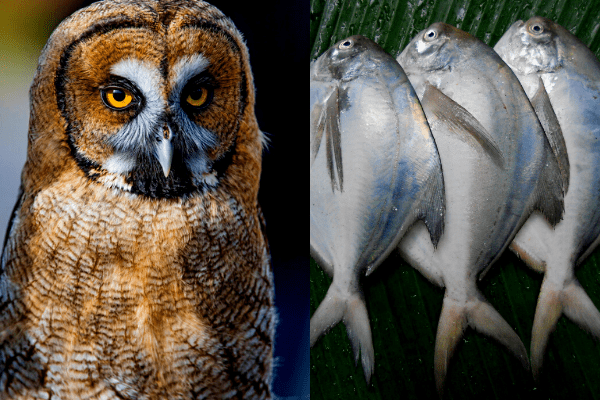
Yes-several owl species do eat fish, but not all owls rely on aquatic prey. Most owls are opportunistic hunters, meaning they eat whatever is abundant in their habitat. Research shows that a few specialized species, like the Blakiston’s Fish Owl, Brown Fish Owl, and Pel’s Fishing Owl, consistently include fish in their diet because they live near rivers, lakes, and wetlands.
Other owls, such as Great Horned Owls and Barred Owls, only take fish occasionally when the opportunity appears. Wildlife studies, pellet analyses, and field observations confirm that owls can snatch fish from shallow water using their long legs, curved talons, and silent flight. Their fishing behavior varies widely depending on habitat, prey availability, and species specialization.
How Often Owls Actually Eat Fish According to Wildlife Studies
Owls aren’t naturally “fish specialists,” but wildlife research shows that a few species have adapted extremely well to life near rivers, streams, and lakes and these owls end up eating fish far more often than the rest of the family. Most owls still depend heavily on small mammals, insects, and birds, but studies from Asia, Africa, and Europe reveal that certain species consistently take advantage of aquatic prey when the habitat supports it.
Researchers studying owl diets use two main tools: long-term field observation and pellet analysis, and both methods point to the same conclusion fish consumption in owls varies dramatically depending on species and region. For instance, the Blakiston’s Fish Owl, the world’s largest owl, lives almost exclusively along salmon-rich rivers in Russia and Japan. Not surprisingly, fish make up most of its observed diet in these habitats. Similar patterns appear in the Brown Fish Owl of South Asia and Pel’s Fishing Owl of sub-Saharan Africa, where the presence of slow-moving rivers and high fish density directly influences what these owls hunt.
On the other hand, generalist owls such as Great Horned Owls and Barred Owls only take fish occasionally. Their diet is incredibly flexible, and if a fish swims close enough to the surface or becomes trapped in shallow water they won’t hesitate to snatch it. But research shows this is the exception, not the norm. Their pellet remains and observational records overwhelmingly favor mammals, birds, and amphibians over fish.
Research-Supported Key Points
- Blakiston’s Fish Owl (Russia & Japan): Long-term studies show fish especially salmonid species can make up 60–70% of the diet where available.
- Brown Fish Owl (India, Nepal, Sri Lanka): Pellet studies consistently reveal freshwater fish bones and scales as regular diet components.
- Pel’s Fishing Owl (Botswana, Zambia): Field research documents a heavy reliance on fish, often forming the primary diet in wetland habitats.
- Generalist species (Great Horned Owl, Snowy Owl, Barred Owl) eat fish rarely, usually in response to opportunity rather than preference.
How Owls Grab Fish from Water: Wild Hunting Behaviors Explained
Owls that hunt fish don’t rely on chase or speed the way hawks do they depend on patience, timing, and extremely precise strikes. Wildlife biologists who have spent years studying species like the Blakiston’s Fish Owl and Pel’s Fishing Owl consistently report the same pattern: these owls position themselves quietly above slow-moving water and wait. They choose spots where fish naturally rise toward the surface shallow edges, narrow channels, and calm river bends because this gives them a clear line of sight and a predictable angle of attack.
Once a fish breaks the surface or creates even the slightest disturbance, the owl reacts almost instantly. It extends its long legs and sweeps downward in a controlled motion, hooking the fish with strong, curved talons designed to grab slippery prey. Owls don’t dive underwater the way ospreys do; instead, they stay above the surface, striking from a distance that keeps their feathers dry and their flight unaffected, a contrast that often comes up when discussing What Do Burrowing Owls Eat and how hunting strategies differ among owl species.
In some regions, researchers have even recorded Brown Fish Owls and Pel’s Fishing Owls wading through shallow water to snatch fish directly from below, behaving almost like herons during low-light hours. This shows how adaptable owl hunting behavior becomes when fish are a major food source. Silent flight helps them get into position unnoticed, but their success ultimately comes from stillness and accuracy rather than speed.
Points to Remember
- Owls typically hunt fish from low perches, riverbanks, or tree limbs hanging over the water.
- They target fish in shallow water or near the surface, avoiding deep dives.
- Their long, curved talons provide grip on slippery aquatic prey.
- Silent flight allows owls to reach their hunting position without alerting fish below.
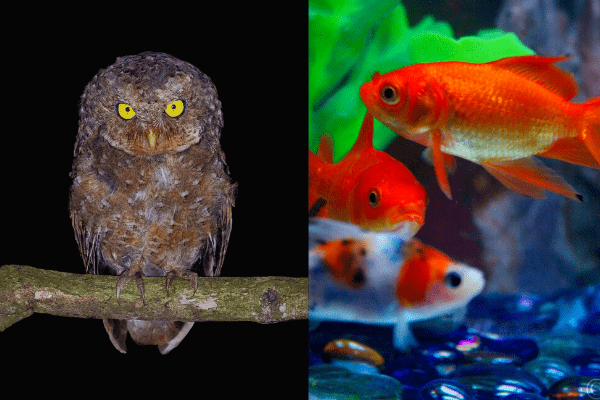
What Researchers Discovered Inside Owl Pellets Near Rivers and Lakes
Pellet analysis is one of the most reliable scientific methods for studying an owl’s diet. Researchers dissect pellets collected near waterways and identify bones, scales, and other undigested materials.
Pellet studies across Asia, Africa, and Europe confirm the presence of:
- Fish vertebrae
- Fish skull fragments
- Scales
- Otoliths (inner ear bones of fish)
In Brown Fish Owls, pellets frequently show a mix of fish and crustaceans. Blakiston’s Fish Owl pellets often contain large fish bones and amphibian remains. Even generalist owls like Great Horned Owls occasionally show fish fragments in pellets collected near lakes.
Which Owl Species Eat Fish the Most? A Breakdown by Habitat and Region
Fish-eating owls are more common in regions with dense water systems, rich fish populations, and stable wetland ecosystems. Habitat plays a major role in shaping diet.
Here are the most fish-dependent species confirmed by scientific studies:
Major Fish-Eating Species (Well-Documented)
- Blakiston’s Fish Owl (Japan, Russia, China)- heavy fish dependence
- Brown Fish Owl (India, Pakistan, Nepal, Sri Lanka)
- Pel’s Fishing Owl (Botswana, Zambia, Mozambique)
Moderate / Occasional Fish-Eaters
- African Wood Owl (opportunistic near rivers)
- Barred Owl (USA & Canada- will take fish from shallow waters)
- Great Horned Owl (North America- rare but documented)
- Snowy Owl (Arctic- fish taken only when accessible)
Habitat Influence
- Wetlands = higher fish intake
- Forests near rivers = mixed diet with some fish
- Arid or mountainous habitats = almost no fish consumption
Rare Fishing Events Captured by Researchers and Wildlife Cameras
While dedicated fish-eating owls regularly hunt in rivers and wetlands, some of the most fascinating discoveries in owl research come from unexpected fishing attempts by generalist species. These moments are usually captured by accident through conservation camera traps, wildlife researchers conducting long-term monitoring, or birders who happen to be recording at the right moment. Though uncommon, these events offer a rare glimpse into how flexible owls can be when food availability shifts.
Generalist owls like the Great Horned Owl, Barred Owl, and Snowy Owl are not built as fish specialists, yet documented cases show they will take fish when the opportunity presents itself. For example, Great Horned Owls have been recorded catching fish from farm ponds in the United States, and Barred Owls have been filmed hunting small fish along lake edges behavior supported by pellet studies showing the occasional presence of fish bones. In northern regions, Snowy Owls have even been observed grabbing fish trapped near ice openings during harsh winters, reinforcing how adaptable they become when small mammals are harder to find.
These rare fishing incidents are important because they connect two worlds of data: field observation and pellet analysis. When camera evidence matches remains found in pellets, researchers gain a much clearer understanding of how owls adjust their diet under changing environmental conditions.
Rare Footage of Owls Catching Fish in the Wild
Related Post
- Do Owls Eat Fish : Read The Explanation
- Do Owls Eat Birds : Let’s Understand Why
- Do Hawks Eat Owls – Explanation
- Do Owls Eat Chickens – Explanation
- Do Owls Eat Squirrels – Explanation A To Z