
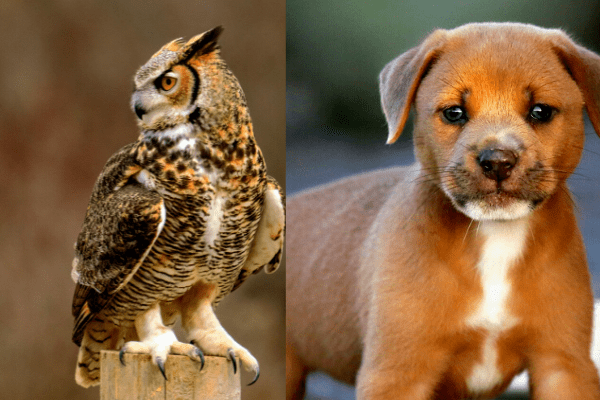
Yes- large owls (most notably the Great Horned Owl in North America) can and sometimes do prey on very small dogs and puppies. These incidents are rare and opportunistic, not part of an owl’s normal diet, but documented cases show that very small pets left unattended outdoors at night can be attacked, injured, or, in uncommon circumstances, killed. Most medium and large dogs are too heavy to be carried or reliably subdued by owls.
How Small a Dog an Owl Can Actually Carry According to Wildlife Data
Large owls are powerful hunters, but their lifting strength is closely tied to their own body weight. Most adult owls that have been involved in pet incidents weigh only a few pounds themselves, which naturally limits the size of any animal they can carry. Wildlife studies on raptor flight mechanics show that once the weight of the prey approaches the bird’s own weight, gaining altitude becomes extremely difficult especially if the animal is struggling.
This is why dogs above a few pounds are rarely lifted off the ground. Even when an owl does attempt to grab a very small dog or puppy, the result is often a brief strike or a short drag rather than a successful carry-off. The bird may cause injury, but the physics of flight make it unlikely for an average or even small adult dog to be removed from the ground.
In reality, the risk is limited to dogs that are exceptionally small typically toy-sized adults or very young puppies. These are the only pets light enough for an owl to attempt to lift, and even then, most encounters end in the owl releasing the dog rather than flying away with it.
Dog Breeds Most at Risk During Nighttime Owl Activity
Toy breeds and lightweight dogs are the most vulnerable because their size overlaps with prey owls normally hunt. Breeds such as Chihuahuas, Yorkshire Terriers, Maltese, Pomeranians, and newborn puppies fall into the weight category owls might mistake for rabbits or rodents. Wildlife organizations note that attacks happen when pets are small, alone, and unsupervised during hours when owls hunt.
Larger small breeds, such as French Bulldogs or adult Dachshunds, are usually too heavy to be targeted. The risk sharply declines as the dog’s weight increases beyond the few-pound range.
How Owl Talon Strength Compares to a Dog’s Neck and Back Strength
Large owls especially Great Horned Owls are built to subdue prey using enormous pressure from their talons. Their grip is strong enough to kill animals such as rabbits and skunks, and wildlife biologists consistently describe their feet as the primary weapon during a hunt. The talons close with a locking mechanism that allows the owl to maintain hold with minimal effort, and this is why even wild animals that struggle vigorously may not immediately escape.
But applying that same force to a dog is a different challenge. A dog’s neck, shoulders, and back are supported by far denser muscle groups than the wild mammals owls normally target. Even a very small dog has thicker skin, stronger vertebrae, and a greater ability to twist or pull away once grabbed. This resistance makes it far harder for an owl to maintain the kind of stable, unmoving grip required to kill or lift an animal.
Because of this mismatch, most verified owl–dog encounters do not involve successful predation. Instead, the dog often ends up with puncture wounds, scratches, or bruising, and in many cases the owl releases the dog quickly either because the dog struggles or because the owl cannot maintain a secure hold. Situations like this are why people ask Are Owls Dangerous, since complete kill-and-carry events are extremely uncommon not because the owl lacks offensive ability, but because a domestic dog’s body structure and behavior make subduing it far more difficult than subduing typical prey.
How Puppies Become Easy Targets in Areas With Large Owls
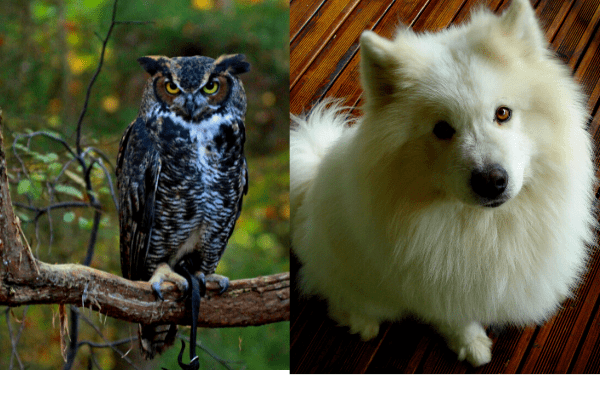
Puppies are at increased risk because they are small, unaware of predators, and move in unpredictable ways that resemble prey behavior. Owls rely on movement patterns when hunting, and a small puppy wandering alone in a yard or dim area can trigger a mistaken strike. Wildlife groups note that most pet-targeting events occur when an animal is young or unusually small.
Risk decreases significantly once a puppy grows beyond a few pounds and becomes visually distinguishable from typical prey.
How Nighttime Dog Walking Can Trigger Accidental Owl Encounters
Owls rely heavily on movement and silhouette when identifying prey, and nighttime conditions make these cues easier for them to misinterpret. During dusk and after dark when owls are most active a small dog walking beneath trees, streetlights, or open sky can create the same size and motion profile as the wild animals owls normally hunt.
From above, especially at a distance, a trotting toy-breed or a young puppy can resemble a rabbit, squirrel, or other small mammal. This is why a handful of accidental encounters occur during evening or late-night walks.
Even so, owl attacks on dogs during walks remain uncommon. Most owls avoid areas with regular human activity, and the presence of an owner typically discourages close approaches. The risk increases mainly in quieter neighborhoods, wooded pathways, or dimly lit areas where an owl may not immediately distinguish between a pet and its usual prey.
Keeping a small dog close, using reflective or illuminated gear, and choosing open, well-lit routes significantly lowers the chance of an owl misidentifying the animal during its hunting hours.
Signs Your Dog Is Being Watched by an Owl in Your Backyard
Owls leave clear, repeatable clues where they roost and hunt. The most reliable sign is pellets compact balls of fur, bone and other indigestible parts that owls regurgitate from the same perch over and over; finding several pellets in one spot strongly indicates a regular roost.
You may also find feathers, droppings, or the scattered remains of small mammals beneath high perches; these are the same traces wildlife biologists and rehabilitators use to identify active hunting sites. Some owl species have distinctive calls persistent hooting from a single tree or rooftop at dusk and after dark can point to a resident bird, and field guides (and sound libraries) let you match calls to species if you want to confirm which owl it is. Together, pellets + feathers + repeated hooting form the best evidence that an owl is using your yard as hunting ground.
Dogs themselves can give behavioral warnings. A small dog that suddenly hesitates to enter a particular corner of the yard at night, freezes and stares upward, or acts unusually skittish after dusk may be sensing something humans do not owls hunt silently and a pet’s sudden alertness is worth noting.
While these behaviors are not proof of a predator, they are practical, real-world clues that owners should not ignore. Expert advice is consistent: when signs of roosting or repeated owl activity appear, keep small pets supervised or bring them indoors after dark.
Real-World Reports of Owls Targeting Dogs: What’s Documented
There are verified cases of large owls attacking pets. The Alaska Department of Fish & Game reported an incident involving a Great Horned Owl attacking multiple pets, including small dogs, over several days. The International Owl Center also confirms that large owls have, on rare occasions, killed or injured very small dogs. These events are unusual but real, and they demonstrate that an owl may attack a dog under specific conditions.
Despite these cases, wildlife biologists consistently note that predation on dogs is not normal owl behavior. These incidents represent rare exceptions rather than a pattern.
Why Small Dogs Are Sometimes at Risk From Owls in Certain Parts of the United States
Great Horned Owls are found throughout most of the United States, and they thrive in wooded neighborhoods, farmland edges, and suburban areas where small mammals are abundant. Because these owls hunt by watching for movement in dim light, a very small dog moving across a yard at night can resemble the wild prey they normally pursue. The risk is not widespread or constant, but in regions where large owl populations overlap with homes that allow small dogs to roam outdoors after dusk, the chances of misidentification rise. Most reported incidents come from areas where owls regularly hunt in backyards, fields, or tree-lined neighborhoods, and the dog is small enough to fit the size profile of typical owl prey.
- Risk is highest where Great Horned Owls are common and hunt near homes
- Small dogs under a few pounds are most easily mistaken for prey
- Open yards or areas with tree cover create ideal hunting conditions for owls
- Most dog owners will never experience this because the danger is highly localized to certain regions
- Problems occur mainly when small dogs are outside alone during dusk or night time.
Real-World Owl–Dog Incident Reports
1. Great Horned Owl Attacks Multiple Pets in Alaska
Wildlife authorities in Alaska investigated several pet attacks over four nights, where a Great Horned Owl injured or killed small dogs, cats, and rabbits around local homes. ( Source – Link )
2. Small Dog Attacked by Owl in Kansas Neighborhood
A Kansas community issued a warning to residents after a small dog was attacked in a backyard at night. The owl was believed to be a Great Horned Owl, and officials urged pet owners to keep small animals supervised. ( Source – Link )
3. Owl Strikes Dog During Night Walk in Arizona
A dog owner in Scottsdale reported that a large owl swooped down and struck their small dog during a nighttime walk. The incident was captured on video, showing how unexpected these encounters can be in dimly lit areas. ( Source – Link )
4. Louisiana Neighborhood Sees a Series of Owl Encounters
Residents in Luling, Louisiana, reported multiple owl encounters involving small dogs. One dog was treated for deep wounds believed to be caused by a bird of prey, raising concerns in the neighborhood. ( Source – Link )
Ctv News covering owl Attacking Dog
Related Post
- Do Owls Eat Fish : Read The Explanation
- Do Owls Eat Birds : Let’s Understand Why
- Do Hawks Eat Owls – Explanation
- Do Owls Eat Chickens – Explanation
- Do Owls Eat Squirrels – Explanation A To Z