
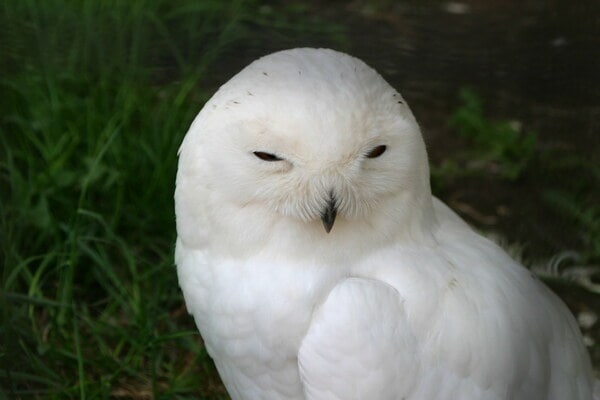
A white owl often carries meaning because it is rare in nature, and humans naturally pay attention to uncommon events. Most white owls people encounter are Snowy Owls, birds adapted to the Arctic with white plumage for camouflage. In other regions, a “white owl” may be a leucistic owl, a genetically lighter individual. Because sightings of these pale owls were unusual, many cultures developed interpretations based on how the birds behaved in the wild.
Inuit communities, for example, described the Snowy Owl as a creature connected to awareness and guidance, while some Indigenous North American traditions viewed unexpected owl sightings-regardless of color-as signals of transition or caution. European folklore often linked white animals with important or meaningful moments simply because they stood out in the environment.
Modern interpretations combine history, ecology, and psychology. Rare wildlife encounters tend to feel significant, and ecological factors such as migration shifts or prey shortages, can explain why a white owl appears in new areas.
In essence, a white owl is often seen as a sign of change, heightened awareness, or an important moment, not because of fantasy, but because its rarity and behavior naturally draw human attention.
What Different Cultures Saw in a White Owl After Watching Them in the Wild
Across the world, the meaning of a white owl grew from people simply watching how these birds moved through real environments. Inuit communities, who lived alongside Snowy Owls for generations, paid close attention to the way these birds sat quietly for long stretches, scanning the land with remarkable stillness. This behavior naturally led to associations with patience, focus, and awareness, not because the culture invented stories around them, but because these traits were repeatedly observable in daily life.
In several Indigenous North American traditions, an owl’s sudden appearance was often treated as a moment to pause and consider one’s surroundings. These interpretations came less from the owl’s color and more from its nocturnal nature, its unexpected timing, and its ability to appear silently without warning. A pale or white owl simply intensified that moment because it was visually uncommon.
In Europe, white animals in general often carried significance because they stood out sharply against forests, fields, and winter landscapes. A white owl’s presence was rare enough to feel important, and people noticed when these birds appeared during harsh winters or periods of seasonal change. Over time, these real encounters shaped meaning that felt grounded rather than imagined. A white owl was a creature people watched carefully because its rarity and behavior demanded attention, and the meanings that developed across cultures came from those lived observations rather than superstition.
The Symbolism People Attached to White Owls After Observing Their Solitary, Silent Behavior
People who lived close to natural landscapes often learned to read animals by watching how they moved, and owls, especially pale or white individuals, left strong impressions. Their silence was one of the first traits that captured human attention. Owls fly with specialized feather structures that reduce sound, allowing them to move through the air almost invisibly. For anyone walking through forests, tundra, or open plains, a white owl appearing without a single audible cue felt remarkable. It is not surprising that many traditions linked this quiet presence to ideas of insight, awareness, or the sense that something deserved closer attention.
The solitary nature of owls added to this interpretation. Unlike many birds that gather in flocks, most owls hunt alone, watching carefully before making a single precise move. People who observed this behavior often connected it to independence or thoughtful decision-making.
A white owl intensified these impressions because it was visually distinct, especially against winter backgrounds or low light. In many communities, a rare encounter with such a bird felt like an important moment, not because of invented stories but because the owl’s real behavior suggested a creature attuned to its surroundings. Over generations, this combination of silence, solitude, and rarity shaped the symbolism people attached to white owls in a way that felt natural, earned, and rooted in observation.
What Seeing a White Owl Might Mean Today, Based on History, Ecology, and Human Psychology
When people see a white owl today, their reaction is often shaped by a mixture of cultural memory and modern understanding. Many still feel that a sighting carries weight, not because of superstition, but because rare events naturally stand out in the human mind. Psychology research consistently shows that people pay closer attention to experiences that break from routine, and a white owl is one of those moments. Its distinct appearance makes the encounter feel intentional, even if the explanation lies in nature rather than symbolism.
Ecology adds another layer to how we interpret these sightings. Snowy Owls occasionally travel far beyond their Arctic range when prey populations shift, a phenomenon that brings them into regions where they are seldom seen. In other places, a pale or white owl may simply be a leucistic individual, which is uncommon enough to feel unusual to anyone who notices it. When these birds appear unexpectedly, people often pause and wonder what the sighting means in the context of their own life. Modern meaning is shaped as much by personal reflection as by the long history of how cultures have responded to rare animals. A white owl still feels significant today because its presence is unusual, visually striking, and tied to patterns of nature that people instinctively try to interpret.

The Real Behaviors Behind the Myths: How White Owls Act in Nature and Why It Matters
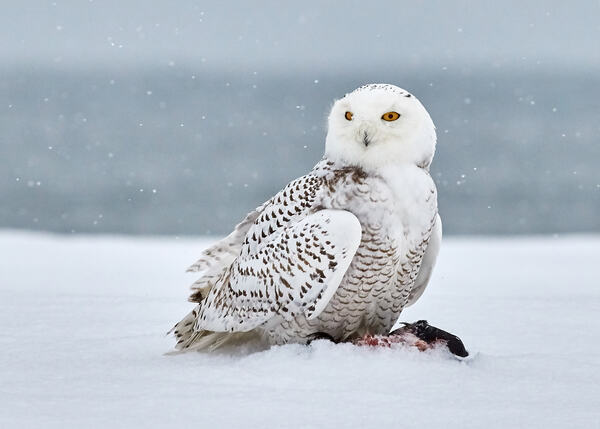
Much of what people believe about white owls can be traced back to behaviors that scientists have been able to document over time. Snowy Owls, the species most commonly associated with a white appearance, are unusual among owls because they are often active during the day. This daylight activity, paired with their bright plumage, made them easier for early communities to observe, which naturally contributed to the meanings people attached to them.
Their white feathers, however, are not symbolic by design. They are an evolutionary adaptation that allows these birds to blend into Arctic snowfields, helping them avoid predators and stalk prey with less risk of being seen.
Their hunting behavior also played a role in shaping human interpretation. Snowy Owls spend long periods sitting quietly, watching the landscape before making a swift and accurate strike. To people encountering this bird in the wild, such patience looked intentional, almost thoughtful, even though it was simply a survival strategy.
Their ability to fly with minimal sound added another layer to their presence, creating moments where they seemed to appear without warning. When prey populations shift in the Arctic, Snowy Owls sometimes travel long distances in search of food, which explains why they occasionally appear in regions far from their usual range.
When myths and stories are compared with these observable traits, it becomes clear that many symbolic ideas surrounding white owls were inspired by real behavior rather than fantasy. People watched these birds closely, and over generations, meanings developed from what they could see and understand about how the owl survived in its environment.