
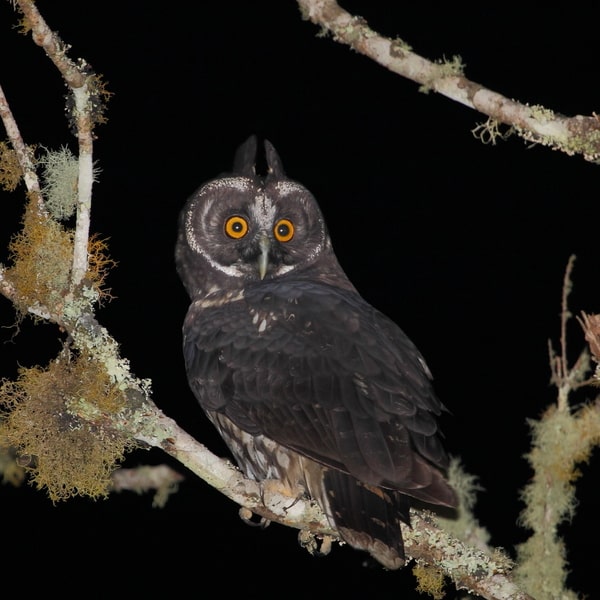
The Stygian Owl (Asio stygius) is one of those birds that manages to be widespread and nearly invisible at the same time. It lives across parts of Central America, South America, and the Caribbean, yet most people who live within its range never notice it. This is not because the owl is especially rare, but because it is exceptionally good at staying out of sight.
Its dark plumage blends easily into forest shadows, and it prefers dense woodlands where visibility is limited. Unlike owls that perch openly or hunt near human settlements, the Stygian Owl keeps to forest edges and hunts quietly after dusk. Many confirmed records come from sound rather than sight, which explains why researchers know the species well, while birdwatchers often don’t.
Scientifically, the Stygian Owl is not a mystery species. Its diet, behavior, and broad range are well documented, even if details like nesting success are harder to observe. Understanding this owl means understanding restraint. It does not adapt loudly or dramatically. Instead, it survives by remaining subtle, steady, and mostly unseen-a reminder that some wildlife thrives precisely because it avoids attention.
Physical Features of the Stygian Owl
Seeing a Stygian Owl for the first time often leaves a different impression than photographs suggest. In flight or at rest, it appears heavier and more solid than most forest owls, with a broad wingspan and a large, rounded head that give it a distinctly powerful outline. This is not a delicate-looking species. Its proportions reflect an owl built for steady, controlled flight through wooded landscapes rather than quick maneuvering in open terrain.
The plumage is notably dark, ranging from deep brown to nearly black in some individuals. This darkness is broken by streaking along the underparts, which helps soften the owl’s shape in low light rather than making it stand out. In forest interiors and along shaded edges, this coloration allows the bird to remain visually muted even at close range.
The facial disc is present but understated, darker than in many owls, and functions primarily as a tool for sound collection rather than visual display. Against this dark face, the yellow eyes are striking and often the first feature noticed when the owl is illuminated.
Long ear tufts rise from the crown, longer than those of many related Asio species, though they are frequently flattened and invisible when the owl is resting. As in most owls, females tend to be slightly larger than males, a difference subtle in the field but consistent across measured specimens.
Subspecies and Regional Differences
Across its wide range, the Stygian Owl appears remarkably consistent, which can make the idea of subspecies feel abstract at first. Unlike birds that show obvious regional color forms or dramatic size changes, this owl changes quietly from place to place. To most observers, a Stygian Owl in Mexico looks much like one in South America or the Caribbean, even though these populations have been separated for long periods of time.
Ornithologists nonetheless recognize several subspecies within the Stygian Owl, all grouped under the species Asio stygius. These include Asio stygius stygius, Asio stygius lambi, Asio stygius robustus, Asio stygius siguapa, Asio stygius noctipetens, and Asio stygius barberoi. These names did not arise from dramatic visual differences seen in the field. Instead, they reflect populations described from different regions, often based on small shifts in size, plumage tone, or vocal characteristics detected through careful study.
Much of this work was done using museum specimens and limited regional surveys, and modern comparisons remain challenging. Many populations live in remote forests or mountainous areas where consistent fieldwork is difficult. In some cases, traits once thought to define a subspecies may be influenced by local climate, elevation, or habitat rather than deep evolutionary separation. This helps explain why subspecies boundaries within the Stygian Owl have been revisited over time. What remains clear is that geographic isolation has shaped regional populations, even when the differences are subtle enough to escape casual notice.
Range and Preferred Habitat
The Stygian Owl covers a wide stretch of the Americas, a fact that often surprises people given how rarely it is encountered. Its range extends from southern Mexico through Central America, across much of South America, and into parts of the Caribbean. On paper, this makes it one of the more broadly distributed forest owls in the region. In practice, its presence is far less evenly spread.
Within this large range, the Stygian Owl is selective. It favors areas where forest cover remains substantial, particularly places where dense interior woodland meets more open edges. Pine–oak forests, montane woodlands, and mature tropical forests all provide the layered structure the species seems to rely on. These environments offer both concealment during the day and suitable hunting corridors at night.
The owl can be found from lowland forests to higher elevations, but elevation alone does not define its habitat. What matters more is continuity. Areas with frequent disturbance, heavy clearing, or constant daytime activity tend to be avoided. Where forest structure remains intact, the Stygian Owl can persist quietly, using the same landscapes year after year without drawing attention to itself.
Daily Behavior and Activity Patterns
The Stygian Owl follows a largely nocturnal rhythm, with most activity beginning soon after sunset. As daylight fades, it leaves its roost and moves into hunting areas, often along forest edges or beneath the canopy where light levels remain low. During the day, it becomes almost invisible. Roosting sites are typically deep within foliage or high in trees, chosen in places where shadows and cover do most of the work. This habit alone explains why even people living near suitable habitat may never notice the species.
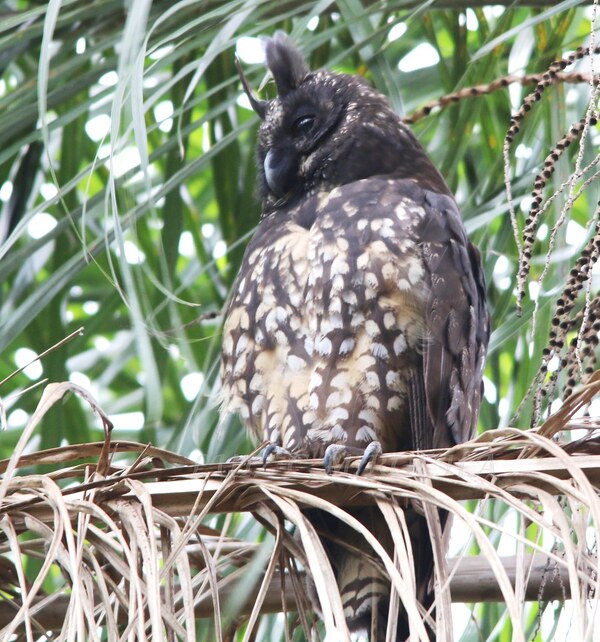
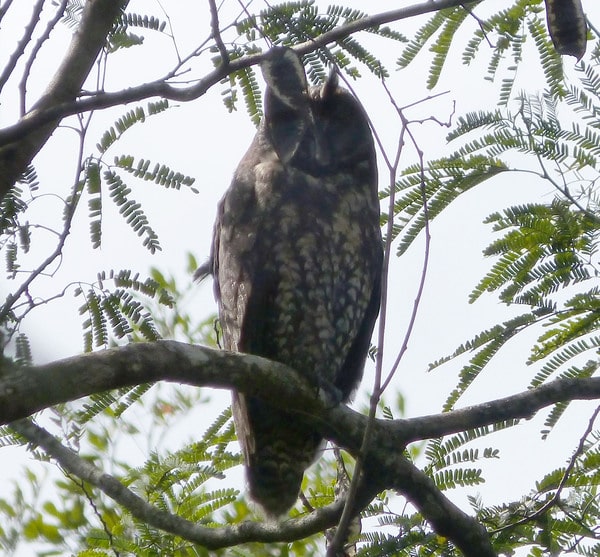
For much of the year, the Stygian Owl lives alone. Individuals tend to use the same general areas repeatedly, suggesting a strong attachment to familiar territory. Open spaces and heavily altered landscapes are usually avoided, and when the owl does encounter disturbance, its first response is rarely to fly.
Instead, it remains still, relying on its dark plumage and quiet presence to go unnoticed. This preference for stillness over movement is one of the reasons the species remains so easy to overlook, even where it is firmly established.
Diet and Hunting Methods
The Stygian Owl does not appear to be a picky hunter. What it eats depends largely on what the surrounding forest offers, and this becomes clear when records from different parts of its range are compared. In some regions, small mammals dominate the diet; in others, birds and large insects appear more frequently. Occasional records of bats likely reflect opportunity rather than preference, taken when prey availability overlaps with the owl’s hunting hours.
Hunting itself is unhurried. The owl moves through the forest with slow, controlled flight, often following edges where cover meets open space. At other times, it waits from a perch, remaining still until prey movement gives itself away. In these moments, sound matters more than sight.
The Stygian Owl is able to locate prey in near darkness or thick vegetation, striking accurately even when visibility is poor. This reliance on hearing, combined with a flexible diet, allows the species to persist in a wide range of forested environments without needing to specialize.
Breeding and Nesting Habits
Breeding is one of the least visible parts of the Stygian Owl’s life, largely because nests are difficult to find and even harder to monitor. This lack of information is common among forest-dwelling owls that breed in remote or densely vegetated areas, where access is limited and disturbance can easily disrupt nesting attempts.
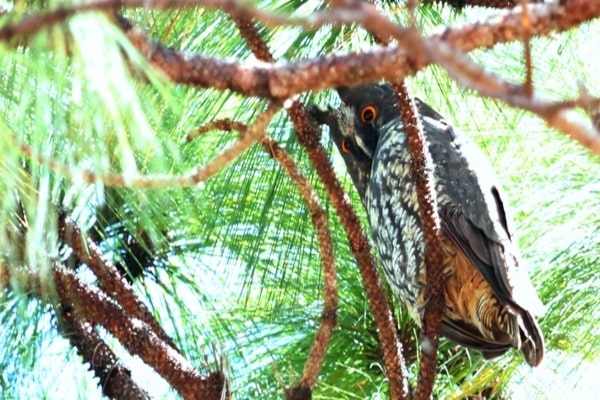

What is known comes from scattered records rather than long-term nest studies. Breeding timing appears to vary depending on location, likely influenced by local climate and prey availability rather than a fixed season across the species’ range. Instead of building its own nest, the Stygian Owl typically uses existing structures, most often abandoned stick nests left behind by other large birds. These nests are usually placed high in trees, adding another layer of difficulty for researchers.
Clutch sizes are small, generally consisting of two or three eggs, which is typical for a large owl. Both adults remain involved during the nesting period, especially in defending the area around the nest. However, detailed observations of chick growth and development are rare, leaving much of this stage of the owl’s life poorly documented.
Calls and Vocal Communication
For the Stygian Owl, sound is often more revealing than sight. Many individuals are first detected not by movement or shape, but by voice, especially in forests where visibility is limited. The owl’s primary call is low and resonant, spaced out rather than repeated rapidly. It is not a sound that draws attention through volume, but one that carries steadily through trees and uneven terrain.
These calls play a practical role. They are used to mark territory and, during the breeding season, to maintain contact between paired birds. Because calls are given at intervals and often from concealed positions, they can be easy to miss unless surveys are conducted deliberately at night.
As a result, a large portion of what is known about the Stygian Owl’s presence comes from acoustic monitoring rather than direct observation. Sound recordings have become one of the most reliable tools for confirming the species in an area, reinforcing how central vocal communication is to both the owl’s behavior and its study.
Conservation Status and Ongoing Risks
The Stygian Owl is currently classified as Least Concern, a status based largely on its broad geographic range rather than on detailed population counts. This designation reflects the fact that the species is still present across much of its historical distribution, not that it is immune to change. For an owl that depends on forest structure and low disturbance, stability is closely tied to the condition of its habitat.
Where large tracts of forest remain intact, Stygian Owl populations appear to persist without obvious decline. The species does not require pristine wilderness, but it does rely on continuity of cover. Problems arise when forests are broken into smaller fragments or removed entirely.
Deforestation, especially when it eliminates mature trees and forest edges, reduces both roosting sites and hunting opportunities. These changes may not cause immediate population crashes, but they can lead to gradual local losses that are difficult to detect.
Because the Stygian Owl is naturally hard to observe, declines may go unnoticed until they are well established. Its conservation status therefore depends less on direct management and more on the long-term preservation of forested landscapes that allow the species to remain quietly present.
Source Link – Data Zone Bird Life
Stygian Owl’s Low Presence in Field Guides
The Stygian Owl appears frequently in scientific literature but far less often in popular field guides. This is not because it lacks importance, but because it is rarely encountered by casual observers.
Its nocturnal habits, forest preference, and reliance on sound rather than visibility mean that most people never realize they are near one. As a result, the species is better known through research papers, museum specimens, and audio recordings than through photographs or sightings.
Reference