
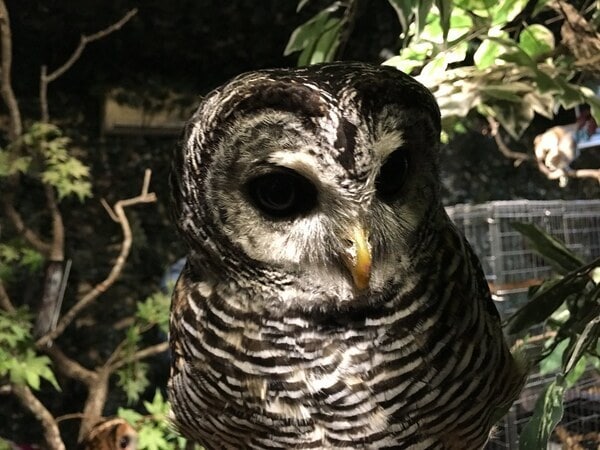
The Rufous-legged Owl is a quiet forest owl found in the temperate woodlands of southern Chile and Argentina. Known to science as Strix rufipes, it spends nearly its entire life inside mature forests, where tall trees, dense canopy, and low light shape how it hunts, rests, and breeds. Unlike owls that adjust easily to farmland or city edges, this species stays tied to well-preserved forest interiors.
Its name comes from the reddish feathers that cover its legs, a feature that blends naturally with bark, shadow, and forest floor debris. At night, the owl hunts from concealed perches, making short, controlled flights to catch small mammals and other prey it detects mainly by sound. During the day, it remains still and well hidden, often pressed against tree trunks where it can go unnoticed even at close range.
Although the Rufous-legged Owl is listed as Least Concern, its presence depends strongly on forest condition. It remains common where native forests are continuous, but it becomes scarce in logged or fragmented areas. This makes the species less a symbol of adaptability and more a reminder that some wildlife survives only when forests are allowed to stay old, complex, and intact.
Species Placement
The Rufous-legged Owl is a member of the genus Strix, a group of owls that live almost entirely within forests. These owls are not built for open landscapes. Their shape, behavior, and hunting style all suit places where trees limit movement and visibility. In such settings, waiting and listening matter more than speed.
Within this genus, Strix rufipes occupies the southern edge of the group’s range. It is confined to the temperate forests of Chile and Argentina, far from the tropical regions where many other forest owls occur. This separation has not created confusion about its identity. The species is well defined and has long been recognized as distinct.
Species Placement
What stands out is how closely its classification matches its lifestyle. Wherever mature temperate forests remain, the Rufous-legged Owl fits the role expected of a Strix owl: quiet, nocturnal, and strongly tied to cover. Its placement reflects a long association with forest environments rather than recent adaptation or expansion into new habitats.
Physical Characteristics
The Rufous-legged Owl is a compact, medium-sized forest owl with a rounded head and no ear tufts, giving it a smooth, solid profile when perched. Adults typically measure a little over thirty centimeters in length, and females are noticeably heavier than males, a pattern common among owls. In hand or at close range, the bird feels dense rather than slender, built more for control than speed.
The face is one of its more distinctive features. Adults have a rusty-toned facial disc, set off by pale markings around the eyes and along the lores. The eyes themselves are dark brown, and above them sit faint whitish “brows” that soften the expression rather than making it striking. In low forest light, these facial details blend easily into shadow.
Across the back and wings, the plumage is dark reddish brown with fine orange-buff bars and small spots. The tail follows the same reddish tone, crossed with lighter buff bars that are easiest to see when the bird is in flight. Below, the throat appears white, while the chest and belly are buffy white with heavy dark barring. The lower belly and vent area take on a warmer, orange-buff shade.
Physical Characteristics
The legs and toes are fully feathered and pale buff in color, a feature that gives the species its common name, though the rufous tone is often subtle unless seen in good light. Young birds look very different. Chicks are covered in soft off-white down, while juveniles show warmer buff plumage with faint brown barring and a tawny-colored face before gradually molting into adult patterns.
Overall, the Rufous-legged Owl’s appearance is not flashy. Its colors and markings seem designed to disappear into bark, moss, and shadow, which is exactly what it does best inside the forests it inhabits.
Geographic Range and Habitat
The Rufous-legged Owl is found only in the southern part of South America, with its range centered in Chile and extending east into adjacent areas of southwestern Argentina. Its distribution is not broad or scattered. Instead, it closely follows the remaining stretches of temperate forest, especially regions where native woodland has remained relatively continuous.
This owl is strongly tied to forest interiors. It is rarely associated with open land, forest edges, or heavily altered landscapes. Most records come from areas with tall, mature trees and a closed canopy, where light levels remain low even during the day. These conditions provide the cover it needs to roost unnoticed and the structure required for nesting in natural cavities.
The species occurs from low elevations up into foothill forests, as long as suitable woodland persists. What matters more than altitude is forest quality. Large trees, standing deadwood, and layered vegetation all contribute to the habitat it depends on. In fragmented forests or areas where logging has simplified the structure, the Rufous-legged Owl becomes uncommon or disappears entirely.
Its range, therefore, is defined less by geography alone and more by the presence of intact temperate forest. Where those forests remain, the owl can still be found. Where they are reduced or broken apart, its absence is often noticeable.
Activity and Behavior
The Rufous-legged Owl is active almost entirely at night. As daylight fades, it begins to move through the forest, shifting between favored perches and listening intently for signs of prey below. Its movements are quiet and deliberate, shaped by a habitat where visibility is limited and sound often provides the first clue that something is happening on the forest floor.
During the day, the owl becomes difficult to find. It spends these hours roosting in dense foliage or pressed against tree trunks, relying on stillness and camouflage rather than flight to avoid attention. Even when disturbed, it often remains motionless, trusting its plumage to blend into bark and shadow rather than revealing itself by moving.
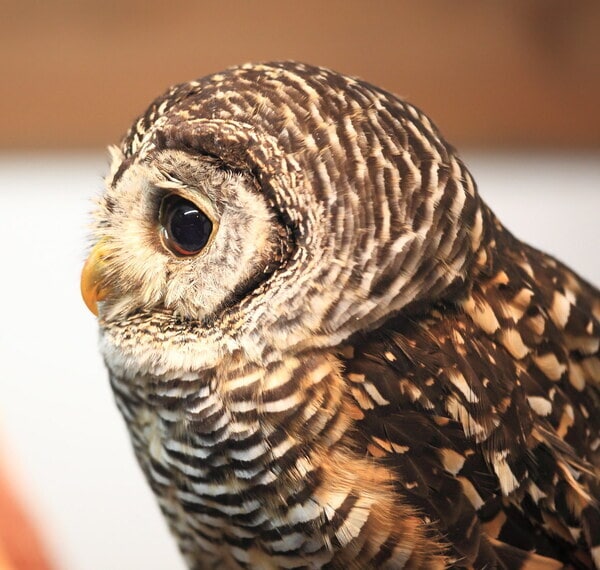
Hunting usually takes place from a perch. The owl waits, listens, and then makes a short, direct flight to seize prey, a method well suited to dense woodland where chasing would be ineffective. This style favors precision over speed and allows the owl to hunt efficiently without expending unnecessary energy. Outside the breeding season, individuals are typically solitary, occupying their own sections of forest and encountering others mainly through vocal contact rather than direct interaction.
Overall, its behavior reflects a life adapted to enclosed spaces. The Rufous-legged Owl does not roam widely or patrol open ground. Instead, it moves carefully within familiar forest patches, shaped by cover, darkness, and sound rather than open skies.
Breeding Ecology
Breeding in the Rufous-legged Owl follows a seasonal rhythm that aligns closely with food availability. The timing varies slightly by location and year, but nesting generally occurs when small mammals and other prey are most abundant, allowing adults to meet the demands of raising young within a forest environment where resources can fluctuate.
This species does not build a nest. Instead, it relies on existing structures, most often natural cavities in large, old trees. Broken trunks, deep hollows, and occasionally abandoned nests created by other large birds provide the sheltered spaces needed for egg laying and incubation. The dependence on such sites means that breeding is closely tied to the presence of mature forest, where suitable cavities are more common.
Clutches are small, reflecting a strategy focused on quality rather than quantity. The female remains at the nest for most of the incubation period, while the male supplies food, delivering prey to the cavity entrance. After the eggs hatch, both adults take part in feeding and guarding the young. Parental care continues well beyond hatching, with the chicks relying on the adults until they are capable of sustained movement and hunting.
This breeding approach works well in stable forest environments but leaves little margin for disturbance. The loss of large trees or nesting cavities can quickly limit breeding opportunities, even in areas where adult owls are still present.
Vocal Behavior
Vocalizations play a practical role in the life of the Rufous-legged Owl, particularly during the breeding season. Its calls are low in pitch and carry well through dense forest, where thick vegetation absorbs higher sounds. These deep notes allow individuals to signal their presence without exposing themselves visually, which suits a species that relies heavily on concealment.
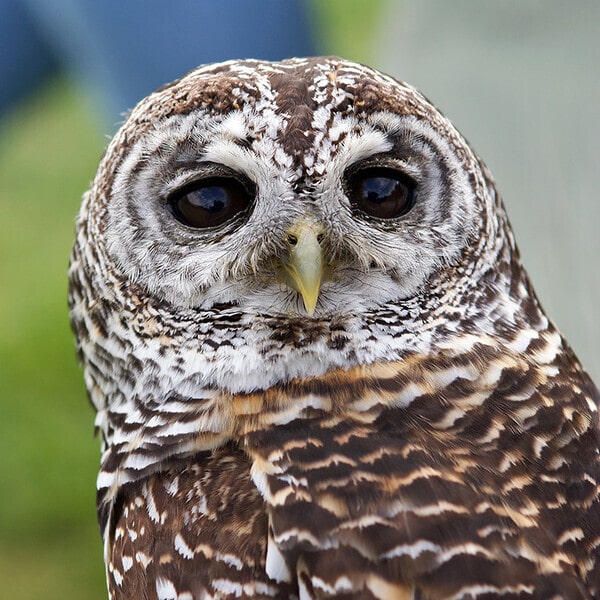
Calling activity increases when territories are being maintained and pairs are forming or reinforcing bonds. Males and females use vocal contact to remain aware of one another’s position, especially in forests where direct visibility is limited. Outside of this period, the species is relatively quiet. It does not call frequently throughout the year, and long stretches can pass without any sound at all.
This restrained vocal behavior contributes to how easily the Rufous-legged Owl is overlooked. Even in suitable habitat, it may remain undetected unless surveys are timed carefully or conducted during peak calling periods. Its voice is effective within its environment, but it is used sparingly, reflecting a species that depends more on remaining unnoticed than on frequent advertisement.
Conservation Status
The Rufous-legged Owl is currently classified as Least Concern at the global level. This status reflects its presence across a broad stretch of southern Chile and parts of Argentina, as well as the lack of evidence for a rapid or widespread population decline. In areas where suitable forest habitat remains, the species continues to occur regularly.
Conservation Status
The Rufous-legged Owl is currently assessed as Least Concern, reflecting its wide distribution and continued presence in intact temperate forests.
At the same time, the owl’s reliance on forest structure makes it sensitive to local change. It is most often found in mature native forests, particularly those with large trees and a complex canopy. Where logging, fragmentation, or conversion to plantations reduces this structure, the Rufous-legged Owl tends to become scarce or vanish from the landscape, even if it persists nearby.
Because of this, its conservation does not depend on species-specific intervention as much as on broader forest protection. Efforts that preserve large, continuous tracts of native woodland and retain old trees with natural cavities indirectly support the species. The Rufous-legged Owl remains secure where forests remain intact, but its future is closely tied to how those forests are managed over time.