
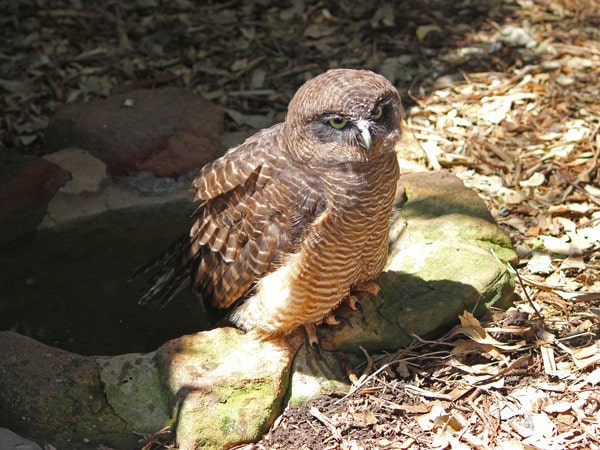
The Rufous Owl is a large forest owl from northern Australia, but size doesn’t help much when it comes to spotting one. Most records come from sound, not sight. People usually hear it first, often without realizing what they’re listening to. The call is deep and steady and carries a long way through woodland, especially at night.
During the day, the bird stays high in tall trees and keeps still. After dark, it becomes active and hunts across a wide area. Its prey includes mammals, birds, and reptiles, taken with strength rather than speed alone.
Rufous Owls need large pieces of forest to survive and are most often found near rivers or well-watered woodland. The species is not listed as threatened, but it does poorly in heavily cleared landscapes. When forests are reduced or fragmented, the owl tends to drop out quietly. Usually the first sign is not a dead bird, but the absence of its call.
Scientific Identity
The Rufous Owl is listed in scientific literature as Ninox rufa. It belongs to the genus Ninox, a group of owls often called hawk-owls. This label comes from how these birds are built and how they fly.
They tend to have longer tails and a more solid body, and when they move through the forest their flight looks direct and deliberate rather than light or drifting.
Scientific Identity
Ornithologists have recognized the Rufous Owl as a distinct species since the nineteenth century, and its classification has changed very little over time. The word “rufous” sometimes causes confusion because it appears in the names of several owls around the world. In this case, it simply describes the reddish-brown coloring of the bird. It does not mean the Rufous Owl is closely related to other owls that happen to share a similar color.
Across northern Australia and into southern New Guinea, the species shows small regional differences. Some populations are slightly larger or darker than others, but these changes follow geography and do not form sharp boundaries.
Because of this, scientists treat these forms as regional variants within a single species rather than separate species. There is broad agreement on this point among modern taxonomic authorities.
Physical Characteristics
The Rufous Owl is a large and solidly built owl, and its size is often the first thing people remark on when they see one well. It has a broad body, wide wings, and strong legs that give it a heavy, powerful look rather than a delicate one. In flight, it appears steady and purposeful, without the buoyant motion seen in smaller owls.
Its feathers are mostly reddish-brown, with darker streaks and bars that break up the outline of the bird when it is perched in shade. This pattern helps it blend into forested surroundings, especially among tree trunks and deep shadow. The face is relatively plain, without the sharply defined facial disc seen in many owls, which gives the head a flatter shape and adds to its hawk-like appearance.
Physical Characteristics
The Rufous Owl is one of the largest owls found in Australia, built with a heavy body, broad wings, and strong legs. Its size and structure reflect a predator adapted for strength and steady flight rather than agility alone.
Juvenile Rufous Owls are noticeably smaller than adults and are covered in soft down during early development. As they mature, their body mass and feather structure gradually approach adult proportions.
The eyes are dark and set forward, and the bill is strong and slightly curved, well suited to gripping and tearing larger prey. As in most owl species, females tend to be larger than males. In the field, this difference is usually subtle and becomes obvious only when a pair is seen together or measured directly.
Geographic Range
The Rufous Owl is found in northern Australia and extends into parts of southern New Guinea. In Australia, records come mainly from the northern areas of Western Australia, the Northern Territory, and Queensland. Even within these regions, the species is not spread evenly. Some forested areas support regular sightings and call records, while nearby areas may have only occasional reports.
Rufous Owls are not long-distance migrants. Individuals tend to remain within the same general region throughout the year, using familiar forest systems rather than moving seasonally across large distances. Because of this, local populations are closely linked to the long-term condition of the surrounding habitat. Where forest cover remains stable, the species is more likely to persist. Where forests change or disappear, records of the Rufous Owl often decline as well.
Distinguishing the Rufous Owl From Other Forest Owls
The Rufous Owl is sometimes confused with other large forest owls, especially the Powerful Owl and the Barking Owl, but there are a few consistent differences. When compared with the Powerful Owl, the Rufous Owl appears warmer in color, with more reddish-brown tones and without the strong white markings across the chest. Its overall look is plainer, and its voice is noticeably slower and deeper.
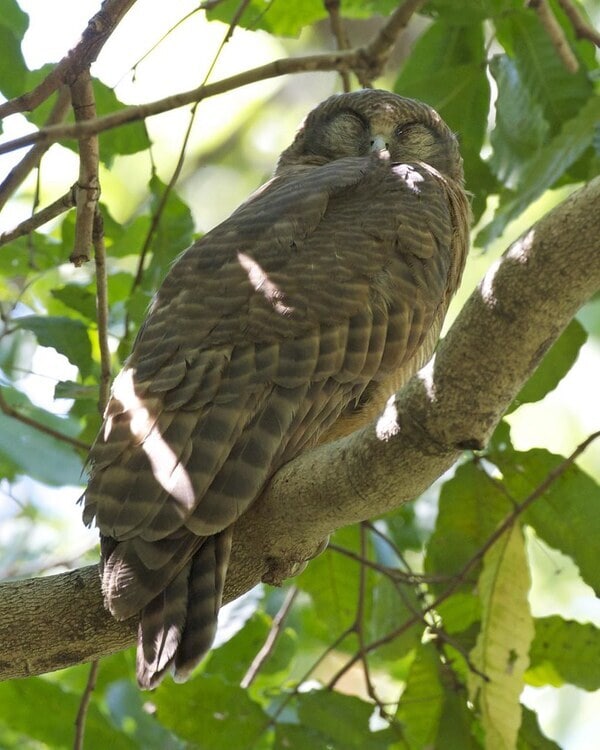
The difference from the Barking Owl is usually clearer. Rufous Owls are heavier and broader, and their call is much lower and more resonant. Barking Owls, by contrast, are smaller and known for sharp, dog-like calls that sound very different once heard side by side. Habitat can also be a useful clue. Rufous Owls are more closely associated with dense, mature forest, particularly in areas near water, while Barking Owls often use more open woodland.
Preferred Habitat
Rufous Owls are most closely associated with mature forest, particularly areas with tall trees and a fairly continuous canopy. They are often recorded in woodland and forest near rivers, creeks, and floodplains, where prey tends to be available throughout the year. These environments also provide the large trees the owls rely on for roosting and nesting.
The species is rarely found in open farmland or built-up areas. While Rufous Owls can persist in forests that have been lightly modified, such as areas affected by selective logging, they do not cope well with heavy clearing. When forests become fragmented or large trees are removed, the owl usually disappears from the area, even if smaller patches of habitat remain.
Daily Activity and General Behavior
The Rufous Owl is active mainly at night. During the day, it spends long hours roosting high in the canopy, often sitting still in dense foliage. When perched this way, it blends easily into the surrounding trees, which is why the species is rarely seen in daylight, even in places where it is present.
After dark, the owl begins to move through its territory. Its flight is strong and direct rather than agile or twisting, and it often hunts from an elevated perch. Instead of prolonged chases, it relies on height, timing, and a short burst of power to capture prey. This steady, energy-efficient approach suits a large owl that ranges over wide forest areas each night.
Feeding Ecology
The Rufous Owl feeds on a wide range of prey, which reflects both its size and the variety of animals available in forest environments. Mammals make up an important part of its diet, particularly medium-sized species, but birds and reptiles are also taken when the opportunity arises. What it eats often depends on what is most common within its territory rather than on strict preference.
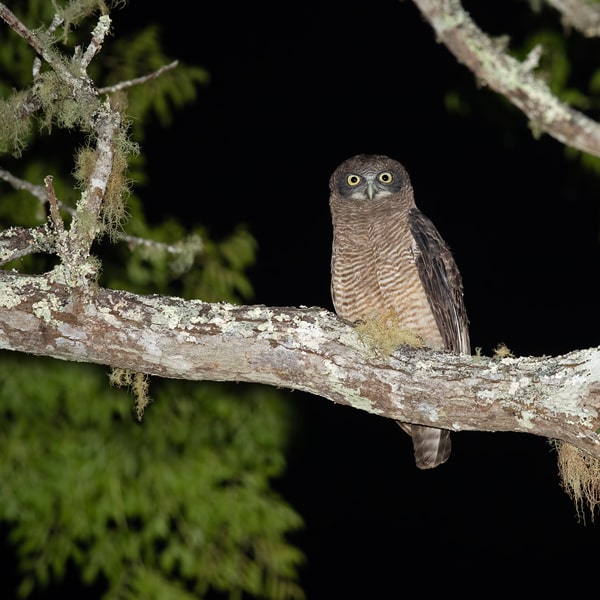
Instead of focusing on a single type of prey, the Rufous Owl hunts whatever it can capture efficiently. This flexible approach allows it to adjust to local conditions and seasonal changes in prey numbers. As long as forest structure remains intact and supports a healthy prey base, the owl is able to meet its needs without specializing too narrowly.
Calls and Acoustic Communication
For most people, the Rufous Owl is known by sound rather than sight. Its call is usually the first and often the only sign that the bird is present. The most common vocalization is a deep, slow note that is repeated at regular intervals and carries a long distance through forest at night. It is especially noticeable during the breeding season, when calling activity increases.
These calls are mainly used to mark territory and to keep contact between pairs. Rufous Owls do not call constantly, and long periods of silence are common. Because of this, the species is often assumed to be rare in areas where it actually occurs. In many cases, it is simply quiet, calling only when conditions or timing make it necessary.
Reproductive Cycle
Rufous Owls usually breed during the warmer part of the year, although the exact timing can shift depending on local conditions and rainfall. Nesting takes place in natural tree hollows, and the species depends heavily on large, mature trees that are old enough to form suitable cavities. Without these trees, breeding opportunities become very limited.
Clutch sizes are small, which is typical for large owls. Both adults play a role in raising the young, with one remaining close to the nest while the other focuses on hunting.
Breeding success varies from year to year and is strongly influenced by food availability and the stability of the surrounding habitat. In seasons when prey is scarce or habitat has been disturbed, pairs may fail to breed successfully or may not attempt breeding at all.
Conservation Assessment
The Rufous Owl is not currently listed as globally threatened, but that simple label hides an important detail. Its long-term outlook depends almost entirely on the condition of forest habitat at a local and regional level. Because the species relies on large areas of mature forest and old trees for nesting, it is particularly sensitive to extensive clearing and gradual habitat degradation.
In areas where broad tracts of forest remain intact, Rufous Owl populations tend to persist with little obvious change. Problems arise where forests are broken into smaller fragments or where large trees are removed over time. In these landscapes, the species often declines quietly rather than disappearing all at once.
This makes changes easy to overlook unless regular monitoring is in place. For the Rufous Owl, conservation is less about emergency intervention and more about protecting forest structure over the long term, especially the mature trees that support breeding and hunting.