
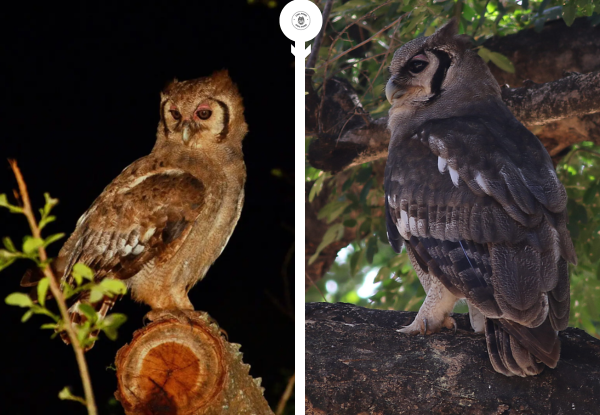
Verreaux’s Eagle Owl is one of Africa’s largest owls, but it is not built for chasing prey across the sky. It relies on strength, broad wings, and long stretches of stillness instead. Across sub-Saharan Africa, it is most often found in open woodlands, savannas, and rocky country, where it spends the night watching quietly from elevated perches.
When it hunts, it waits. Sometimes for a long time. The strike itself is short and direct, dropping down onto prey below rather than pursuing it through the air. Its diet varies by location and includes mammals, birds, reptiles, and amphibians. This ability to take whatever is available helps the owl succeed in very different environments. Its deep, low calls carry well over open ground and are mainly used to define territory and keep contact with a mate.
Despite its size, Verreaux’s Eagle Owl is not known for aggressive behavior toward people. It avoids close contact and is rarely noticed unless it calls. The species is widely distributed and remains stable across much of its range, where it quietly fills the role of a top nighttime predator.
Species Background and Classification
Verreaux’s Eagle Owl is one of those birds whose identity is clear even before its name is explained. Its size, heavy build, and deep voice place it among the large owls commonly known as eagle owls. These are birds defined by strength rather than subtle detail. In African landscapes, this owl stands apart simply through presence. Even when it is not seen, its calls and silhouette make its identity obvious.
Scientific Classification
The scientific name Bubo lacteus comes from a period when species were identified almost entirely by appearance. The word lacteus, meaning “milky,” refers to the pale coloring visible on parts of the owl’s face and underside. These lighter tones are most noticeable when light strikes the feathers at the right angle. Such physical traits were essential to early naturalists, who relied on visible features long before genetics or modern classification methods existed.
The owl’s English name honors Jules Verreaux, a French naturalist who worked extensively in Africa during the nineteenth century. At that time, much of the continent’s birdlife was still being formally recorded. Verreaux’s Eagle Owl was recognized early because it was difficult to overlook. Its size, deep voice, and wide distribution set it apart from most other owls described during that era.
Within Africa, this species holds a clear position among the largest nocturnal predators. While it shares ancestry with other eagle owls, it is less closely tied to dense forests and is more often associated with open landscapes. This preference has influenced how it hunts, where it calls from, and how widely it has been able to spread across the continent.
Physical Features and Size
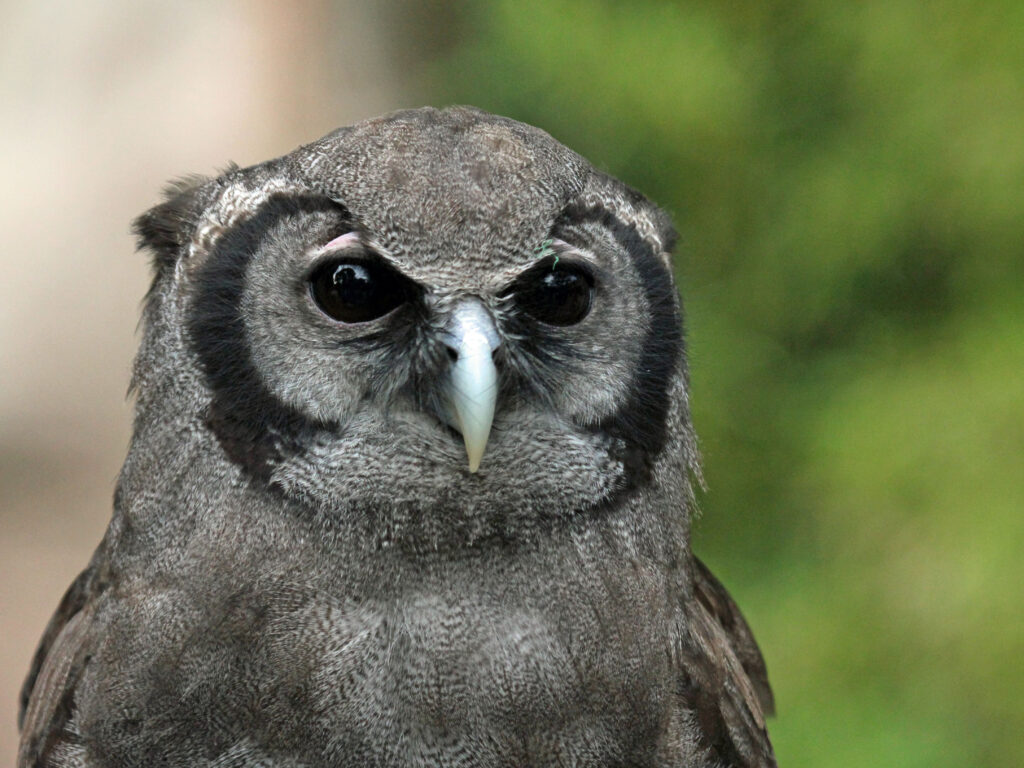
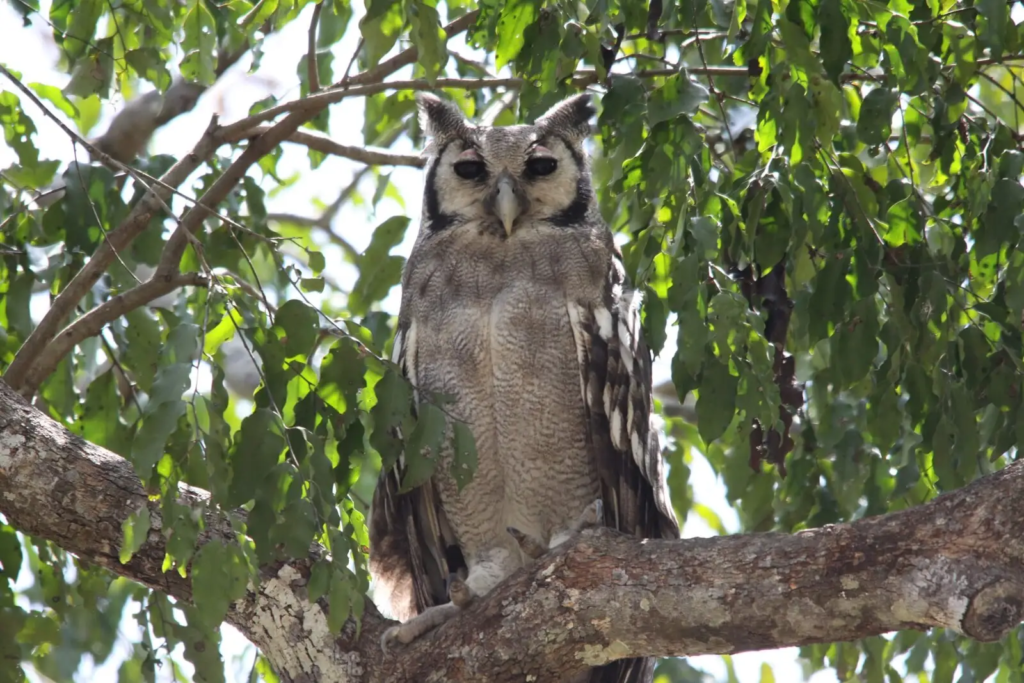
Seeing Verreaux’s Eagle Owl in good light makes its size immediately clear. This is a large, solid bird, built with a kind of weight that feels deliberate rather than bulky. The wings are broad and wide-set, giving the owl a steady, grounded look when it flies instead of anything fast or acrobatic. Its head appears rounded and substantial, with ear tufts that can look prominent at times and almost disappear at others, depending on how alert the bird is.
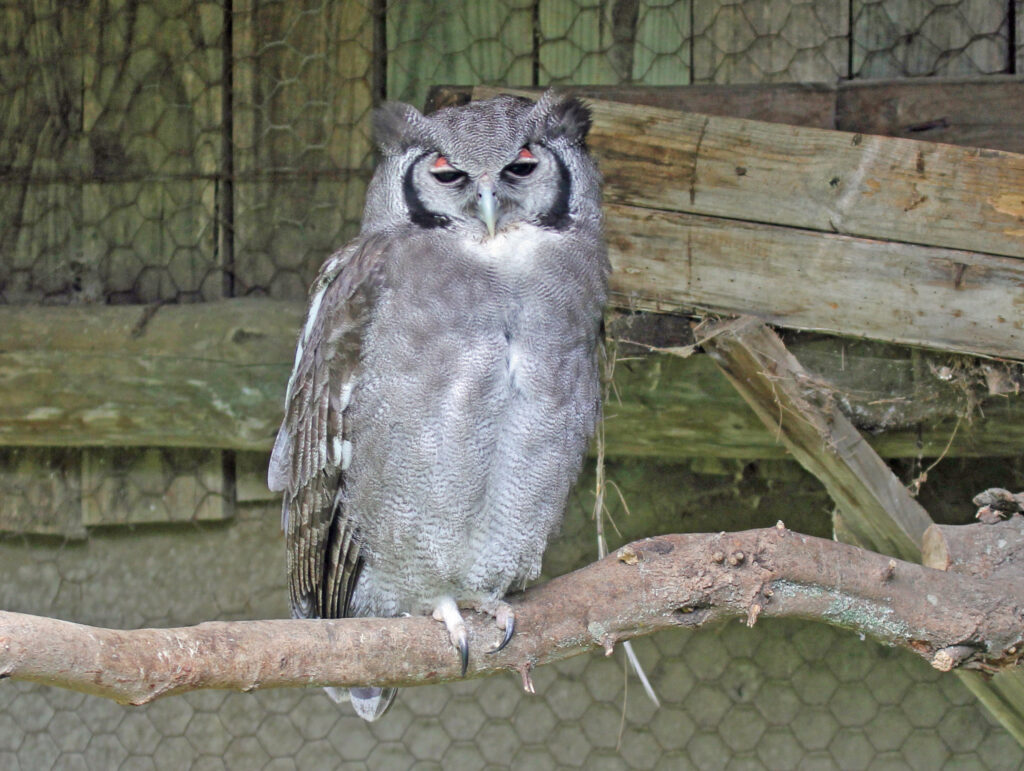
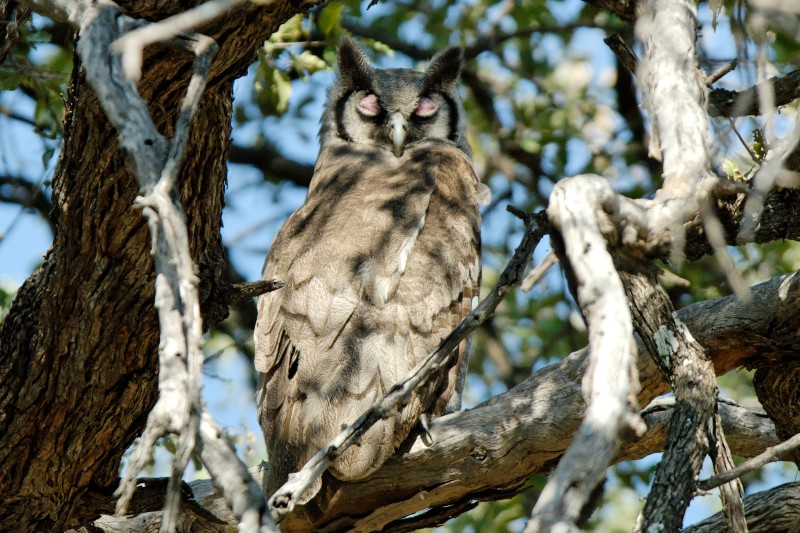
One detail that often surprises people is the color of the eyelids. When the owl blinks or rests with its eyes partly closed, a pink tone becomes visible. This is an unusual feature among owls and is easiest to notice in daylight or soft evening light. The rest of the face blends into the overall plumage, which is mostly gray to brown with fine markings that break up the outline of the body.
Physical Size and Structure
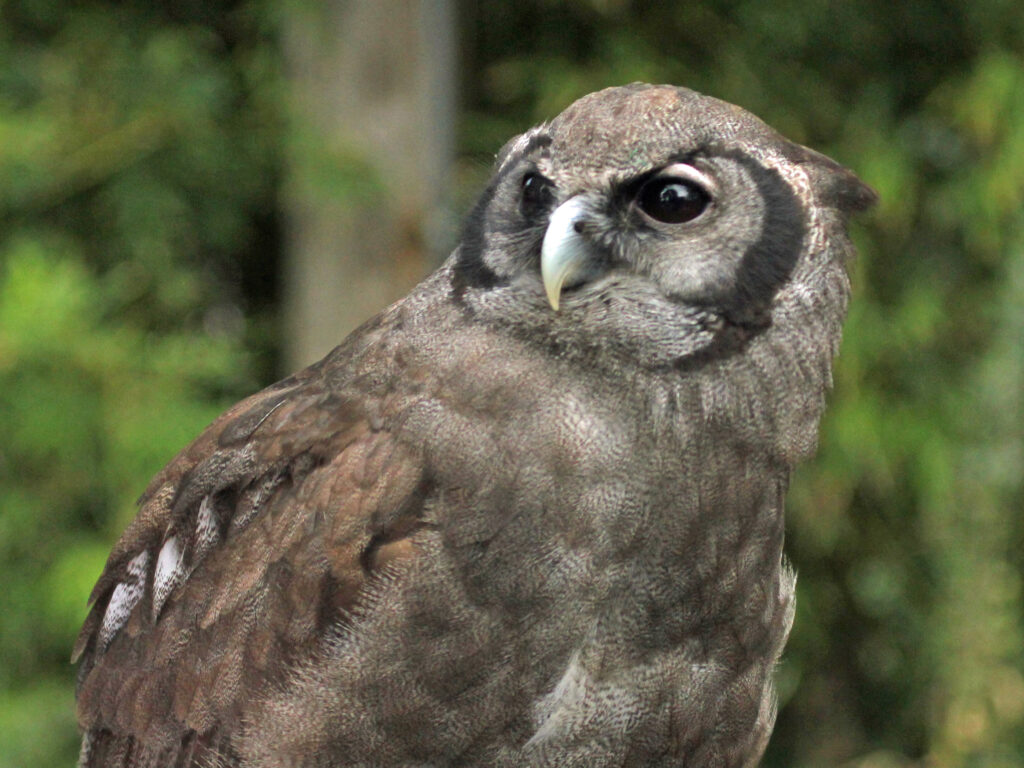
Those markings serve an important purpose. During the day, when the owl is resting, the pattern of its feathers blends closely with tree bark, rocks, and dry woodland surroundings. Even though it is large, it can be surprisingly difficult to notice when it remains still, especially in shaded or rocky places.
Physically, this owl is designed for strength. Its wings support slow, controlled flight rather than speed, allowing it to move quietly and deliberately through the night. The feet are large and powerful, equipped with strong talons that can grip and hold sizeable prey. Adults typically reach about 60 to 66 centimeters in length, with a wingspan that can extend to roughly 140 to 150 centimeters. These proportions place Verreaux’s Eagle Owl among the largest and heaviest owls found in Africa.
Calls and Vocal Behavior
The presence of Verreaux’s Eagle Owl is often known by sound long before the bird itself is seen. Its voice is deep and low, carrying a weight that feels more like a distant echo than a typical bird call. In open country, the sound can travel a remarkable distance, especially at night when background noise fades and the air is still.
Most calling happens after dark. Males and females use these calls to keep track of one another and to signal that a territory is occupied. Rather than calling constantly, the owl tends to vocalize at intervals, letting the sound do the work of carrying across its range. In wide, open habitats such as savannas or rocky plains, a single call can be heard far beyond the bird’s actual location.
Vocal activity becomes more frequent during the breeding season, when maintaining contact between pairs is especially important. Outside of this period, calling still occurs, but less regularly. Compared to smaller owls that rely on repeated or complex calls, Verreaux’s Eagle Owl uses fewer vocalizations overall. The difference lies in power rather than variety. Each call is strong, deliberate, and difficult to ignore.
For many people, hearing this owl is the only encounter they ever have with it. The bird may remain hidden in darkness or perched high above, but its voice announces its presence clearly, often leaving a lasting impression of a much larger animal than what is eventually glimpsed.
Range and Natural Habitat
Verreaux’s Eagle Owl is spread across a large portion of sub-Saharan Africa, and its success is closely tied to the types of landscapes it occupies. Rather than living in dense rainforests or the most extreme desert environments, this owl favors open or semi open areas where visibility and space work in its favor. These settings allow it to hunt from elevated perches and move freely without the obstruction of thick vegetation.
Open woodlands and savannas form the core of its range, but the owl is not limited to flat terrain. Rocky hills, escarpments, and river valleys are also commonly used, especially where cliffs, large trees, or outcrops provide secure roosting sites. In these areas, the owl can spend daylight hours resting quietly before becoming active after sunset.
Verreaux’s Eagle Owl shows a degree of flexibility in how it uses its environment. It can be found at different elevations and will sometimes occupy landscapes shaped by human activity, such as lightly wooded farmland or areas near settlements. As long as there is suitable cover for roosting and a steady supply of prey, the owl is able to persist without close interaction with people. This adaptability helps explain why the species remains widespread across much of the African continent.
Daily Activity and Behavior
Verreaux’s Eagle Owl follows a rhythm shaped almost entirely by darkness. As daylight arrives, it settles into rest, choosing roosting spots that offer both cover and height. Trees, rocky ledges, and cliff faces are commonly used, and once in place the owl relies on stillness as much as camouflage. Even at close range, it can remain unnoticed for hours simply by not moving.
Activity begins soon after sunset. The owl becomes alert and purposeful, leaving its roost to hunt and patrol its territory through the night. Unlike smaller owls that may dart quickly from place to place, Verreaux’s Eagle Owl moves with intention. Its flight is steady, and its time is spent watching, listening, and waiting rather than rushing.
Outside the breeding season, this species is usually solitary. Individuals maintain large, well defined territories that they return to night after night. During breeding periods, pairs remain closely associated and may hold the same territory for many years. This strong attachment to place reflects an energy efficient lifestyle, where familiarity with the landscape allows the owl to hunt effectively without unnecessary movement. Calm, deliberate behavior is a defining trait, and it is part of what allows such a large owl to thrive without drawing attention to itself.
Diet and Hunting Method
Verreaux’s Eagle Owl is an adaptable hunter, and its diet reflects that flexibility. Rather than focusing on a single type of prey, it takes advantage of whatever is most available in its surroundings. This approach allows the owl to survive in a wide range of habitats, from open savannas to rocky landscapes, without depending on one specific food source.
Most hunting begins from a perch. The owl chooses a high vantage point and remains still, watching and listening for movement below. When prey is detected, the attack is brief and controlled. Instead of pursuing animals over long distances, the owl drops down in a direct strike, relying on its weight and powerful feet to secure the catch. This method suits a large bird that favors efficiency over speed.
The range of prey it can handle is impressive. Verreaux’s Eagle Owl regularly takes small to medium sized mammals, along with birds that can be surprisingly large for an owl to handle. Reptiles, including lizards and snakes, are also taken, particularly in warmer regions.
In wetter areas, amphibians may form part of the diet as well. This broad feeding strategy helps explain why the species remains widespread and successful across much of Africa.
How This Owl Hunts Without Speed: Strategy Over Chase
Verreaux’s Eagle Owl is not built for fast aerial pursuits, and its hunting style reflects that. Instead of chasing prey through open air, it depends on patience and timing.
From a high perch, the owl watches the ground below, often remaining still for long periods. During this time, it listens as much as it looks, picking up subtle movements that might go unnoticed by a faster but less attentive hunter. When the moment comes, the attack is direct and controlled.
The owl drops down in a short descent rather than engaging in a prolonged chase. Its size and strength do the work, allowing it to overpower prey quickly. This method is especially effective for a large owl, as it reduces the energy cost of hunting while increasing the chance of a successful capture. Over time, this approach has proven reliable across
Breeding and Nesting Habits
Verreaux’s Eagle Owl does not spend time building a nest of its own. Instead, it makes use of what is already available in the landscape. Old stick nests left behind by large birds, sheltered cliff ledges, and occasionally abandoned platforms all serve as suitable nesting sites. These locations provide safety and height, reducing the risk of disturbance during the breeding period.
The timing of breeding differs across its wide range, but it generally coincides with seasons when prey is more abundant. This ensures that adults can meet the high energy demands of raising young. Once eggs are laid, the female remains at the nest to incubate them, while the male takes on the role of hunting and delivering food.
Parental care does not end once the chicks hatch. Both adults remain involved as the young grow, with food deliveries continuing well after the chicks leave the nest. This extended period of care allows the young owls to develop strength and hunting skills gradually.
Long-term pair bonds are common in this species, and many pairs return to the same nesting areas year after year, reinforcing their connection to familiar territory.
Population Status and Threats
Verreaux’s Eagle Owl is currently considered a species of Least Concern, largely because it occupies a very wide range and maintains stable populations across much of sub-Saharan Africa. Its ability to live in different types of open and semi open habitats has helped it remain resilient compared to more specialized owl species. In many regions, it continues to be a familiar presence, even if it is more often heard than seen.
Conservation Status
That said, stability at a continental scale does not mean the species is free from pressure everywhere. In areas where natural landscapes are heavily altered, local declines can occur. Large trees used for roosting or nesting may be removed, and changes in land use can reduce the availability of suitable prey. These impacts tend to be gradual and uneven, affecting some populations more than others.
The most serious threats facing Verreaux’s Eagle Owl are usually indirect. Habitat loss plays a role, but secondary poisoning is a growing concern in some regions. When rodenticides are used to control pests, poisoned rodents may be eaten by owls, leading to accidental poisoning.
Disturbance near nesting sites can also affect breeding success, especially if it occurs repeatedly. While the species is not currently at risk overall, its long-term health depends on the continued availability of intact habitats and responsible wildlife management practices.
Why Verreaux’s Eagle Owl Rarely Comes Into Conflict With Humans
Although Verreaux’s Eagle Owl is a large and powerful bird, it rarely causes problems for people. Much of this comes down to how it lives. The owl is active at night, when human activity is low, and during the day it chooses roosting sites that keep it hidden from view. By remaining quiet and still, it avoids drawing attention to itself.
Its hunting habits also reduce the chance of conflict. Verreaux’s Eagle Owl focuses on wild prey and does not commonly target livestock or pets. Even in areas close to farms or settlements, it tends to keep a distance rather than investigate human activity. Because of this, many people share the landscape with this owl without ever realizing it is there, apart from hearing its deep calls at night.