
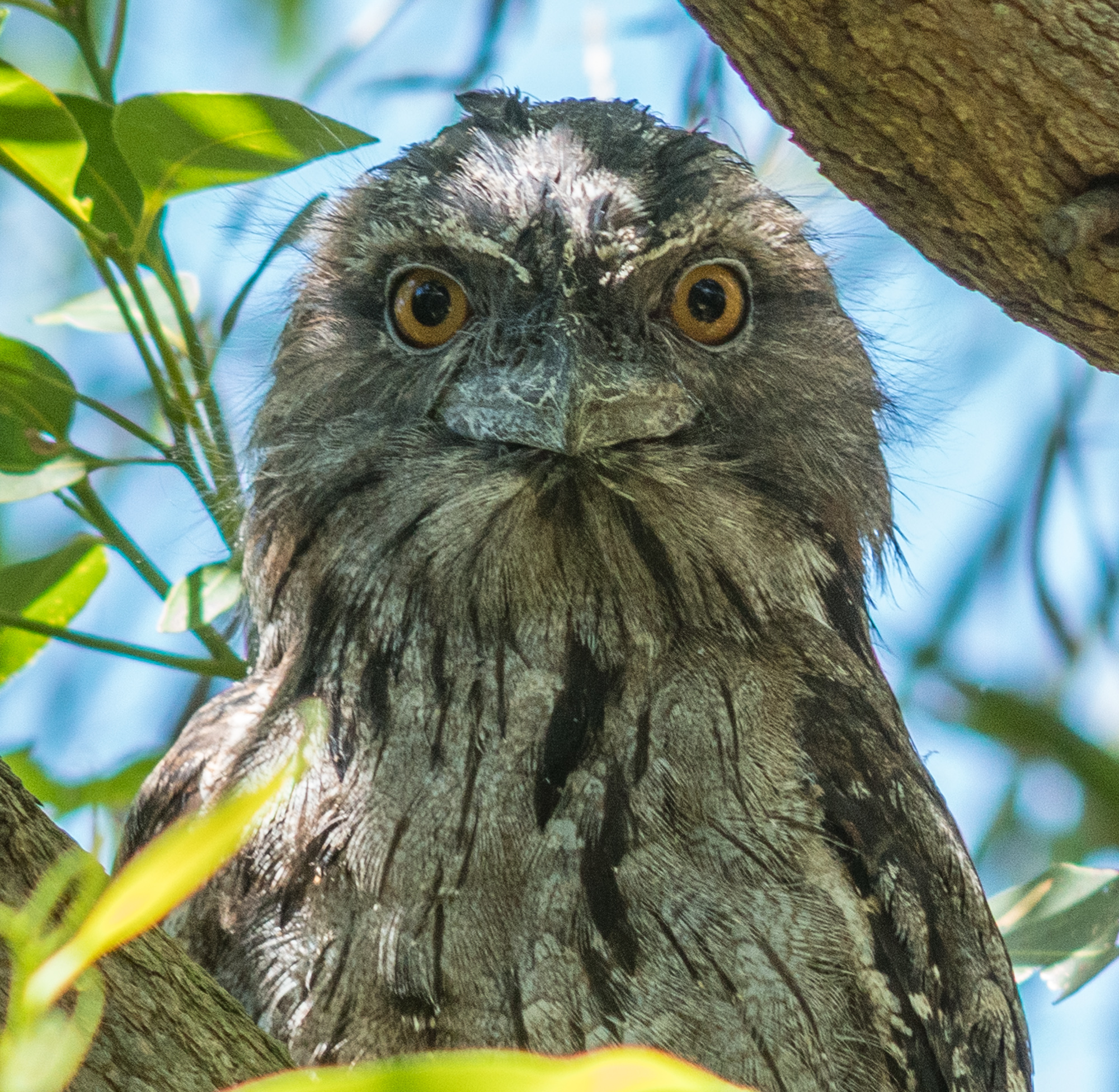
The tawny frogmouth Podargus strigoides is one of those birds that makes people stop and say, “Wait… isn’t that an owl?” It certainly looks like one. Big yellow eyes. Broad head. Active at night. But scientifically, it is not a true owl at all. It belongs to the family Podargidae, while real owls belong to Strigidae. That small detail changes a lot. Frogmouths have weaker feet than owls and rely more on their wide, frog-like beak to catch insects and small animals rather than powerful talons.
Important: The tawny frogmouth (Podargus strigoides) is not a true owl. It belongs to the family Podargidae, while real owls belong to Strigidae.
If you are wondering why an owl-focused website would write about a bird that is not technically an owl, the answer is simple. Many people confuse the tawny frogmouth with owls, and that confusion deserves a clear explanation. We love owls, but we also respect all birds and the roles they play in nature. Understanding the frogmouth helps people better understand what truly makes an owl an owl.
Native to mainland Australia and Tasmania, the tawny frogmouth is famous for its camouflage. By day it perches upright like a broken tree branch, almost impossible to notice. By night it quietly hunts insects, small mammals, and reptiles. It is widespread and currently listed as Least Concern, yet still faces threats from habitat loss and vehicle strikes.
Physical Description
If you see a tawny frogmouth for the first time, the eyes are what usually stop you. Large, round, and yellow, they give the bird a serious, almost thoughtful expression. Adults measure roughly 34 to 53 centimeters in length, with a wingspan that can reach close to a meter. Females are generally a little larger than males, though the difference is subtle.
Its bill is broad and flattened, and the mouth opens surprisingly wide, extending past the eyes. That wide gape is important because this bird often catches prey directly with its beak rather than relying heavily on its feet. Compared to true owls, its talons are relatively weak. The plumage ranges from silvery grey to brownish tones, marked with streaks and mottled patterns that closely resemble tree bark. Some individuals show a more reddish color variation. Every feather pattern serves a purpose. It is not decoration. It is survival.
Scientific Classification
| Kingdom | Animalia |
|---|---|
| Phylum | Chordata |
| Class | Aves |
| Clade | Strisores |
| Order | Podargiformes |
| Family | Podargidae |
| Genus | Podargus |
| Species | P. strigoides |
Taxonomy and Classification
The tawny frogmouth is scientifically known as Podargus strigoides. It belongs to the family Podargidae, within the order Caprimulgiformes. True owls belong to a different order, Strigiformes, which includes the families Strigidae and Tytonidae.
That taxonomic split explains why frogmouths differ in structure and behavior. They do not have the same specialized facial discs for sound direction that owls possess, and their feet are not built for crushing prey. They share nocturnal habits and forward-facing eyes with owls, which is why confusion is common, but evolution placed them on separate branches long ago.
Behaviour and Ecology
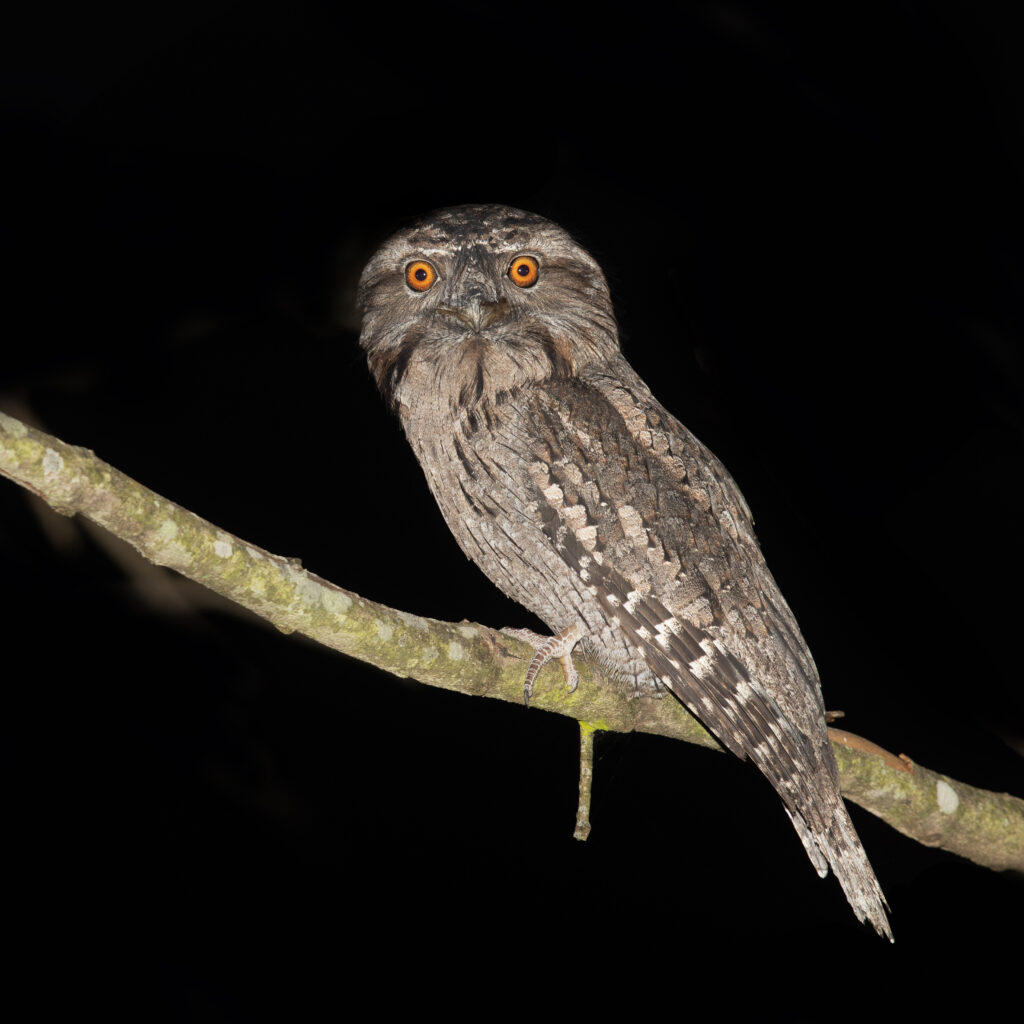
Tawny frogmouths are active mostly after sunset. Rather than soaring widely, they usually hunt from a low perch. When prey moves below, they drop down quickly and seize it with their beak. Insects form the majority of their diet, including beetles, moths, and other large invertebrates. They also take small mammals, reptiles, frogs, and occasionally small birds.
Because they consume large numbers of insects, they contribute to natural pest control in both bushland and suburban environments. During daylight, they remain still for hours, conserving energy and avoiding attention.
Built to Blend: Camouflage in the Daylight Hours
By day, the tawny frogmouth transforms into what looks like a broken branch. It stretches its body upright, tightens its feathers, narrows its eyes to thin slits, and remains motionless. Its streaked plumage blends with bark so effectively that even experienced birdwatchers can miss one at close range.
This form of camouflage, known as cryptic plumage and mimicry, is its primary defense against predators. It does not rely on aggression or flight. It relies on not being seen at all.
Slowing Down to Survive: Winter Torpor
In winter, when insect numbers decline, food becomes harder to find. The tawny frogmouth responds with a physiological strategy called torpor. During torpor, its heart rate and metabolism slow, and body temperature drops for several hours. This is not full hibernation. It is a short-term energy-saving state that can occur daily in colder months.
By lowering energy demands, the bird can survive nights when food intake is limited. This adaptation allows it to live in parts of Australia where winter temperatures can approach or dip below freezing.
Living Through Heat and Cold: Seasonal Body Adjustments
Australia’s climate can be extreme. In some regions, summer temperatures exceed 40 degrees Celsius, while winter nights fall near 0 degrees Celsius. Tawny frogmouths roost in the open, which exposes them to both heat and cold.
In summer, they choose shaded perches and increase their breathing rate to help cool down. When body temperature rises further, they pant and increase blood flow to the mouth, allowing heat to dissipate. In winter, they often select sun-facing branches to absorb warmth and may roost close to their mate to share body heat. These adjustments allow them to remain widespread across diverse environments.
Habitat and Distribution
The tawny frogmouth is found across mainland Australia and Tasmania. It occupies woodlands, open forests, scrub, and even suburban parks and gardens. It generally avoids dense rainforests and completely treeless deserts but adapts well to lightly wooded areas shaped by human activity.
Its tolerance of urban and rural environments is one reason the species remains common in many areas.
Reproductive Biology
Breeding usually takes place from August through December. Pairs often form long-term bonds and may reuse nesting territories. The nest itself is simple, typically a loose platform of sticks placed on a horizontal tree branch.
The female usually lays two or three eggs. Both parents share incubation duties for about 30 days. After hatching, both adults participate in feeding and protecting the chicks.
Early Development
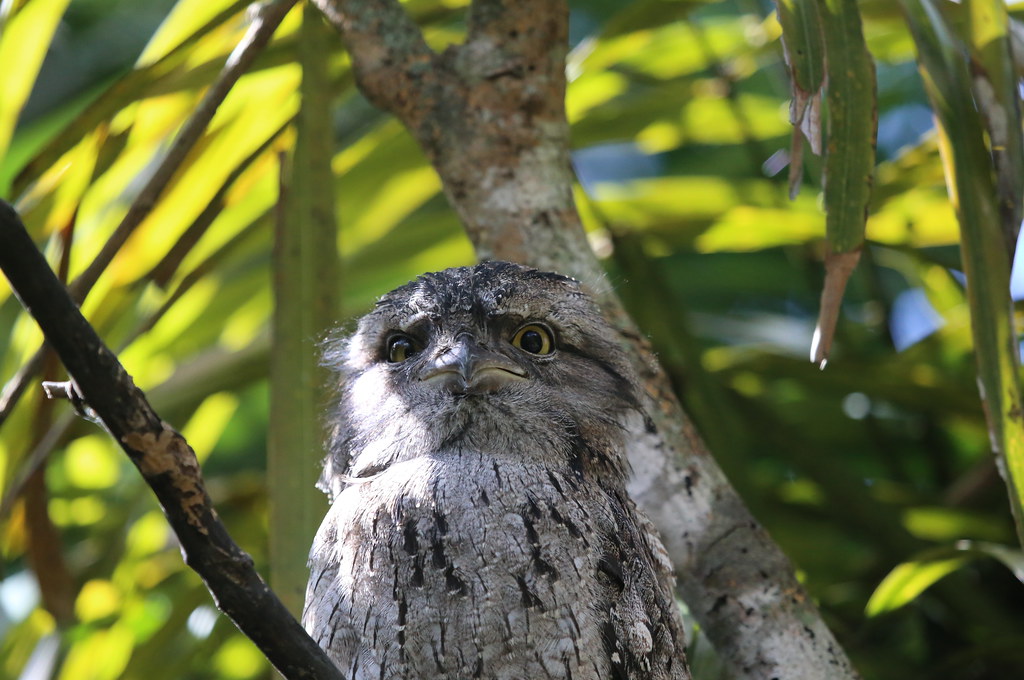
Newly hatched chicks are covered in soft down and depend entirely on their parents. They grow quickly, developing feathers within weeks. Fledging generally occurs around one month after hatching, although young birds may stay near the nest area while learning to hunt effectively.
As juveniles mature, their plumage gradually develops the same bark-like pattern that defines adults.
Conservation Status
The tawny frogmouth is currently classified as Least Concern due to its wide distribution and stable overall population. However, this does not mean it faces no risks. Vehicle collisions are common, especially when birds hunt insects attracted to headlights. Habitat clearing reduces available nesting sites, and secondary poisoning from rodenticides can affect individuals that consume poisoned prey.
Understanding these threats helps people make informed choices. Preserving habitat and using wildlife-safe pest control methods can make a meaningful difference for this remarkable bird.