
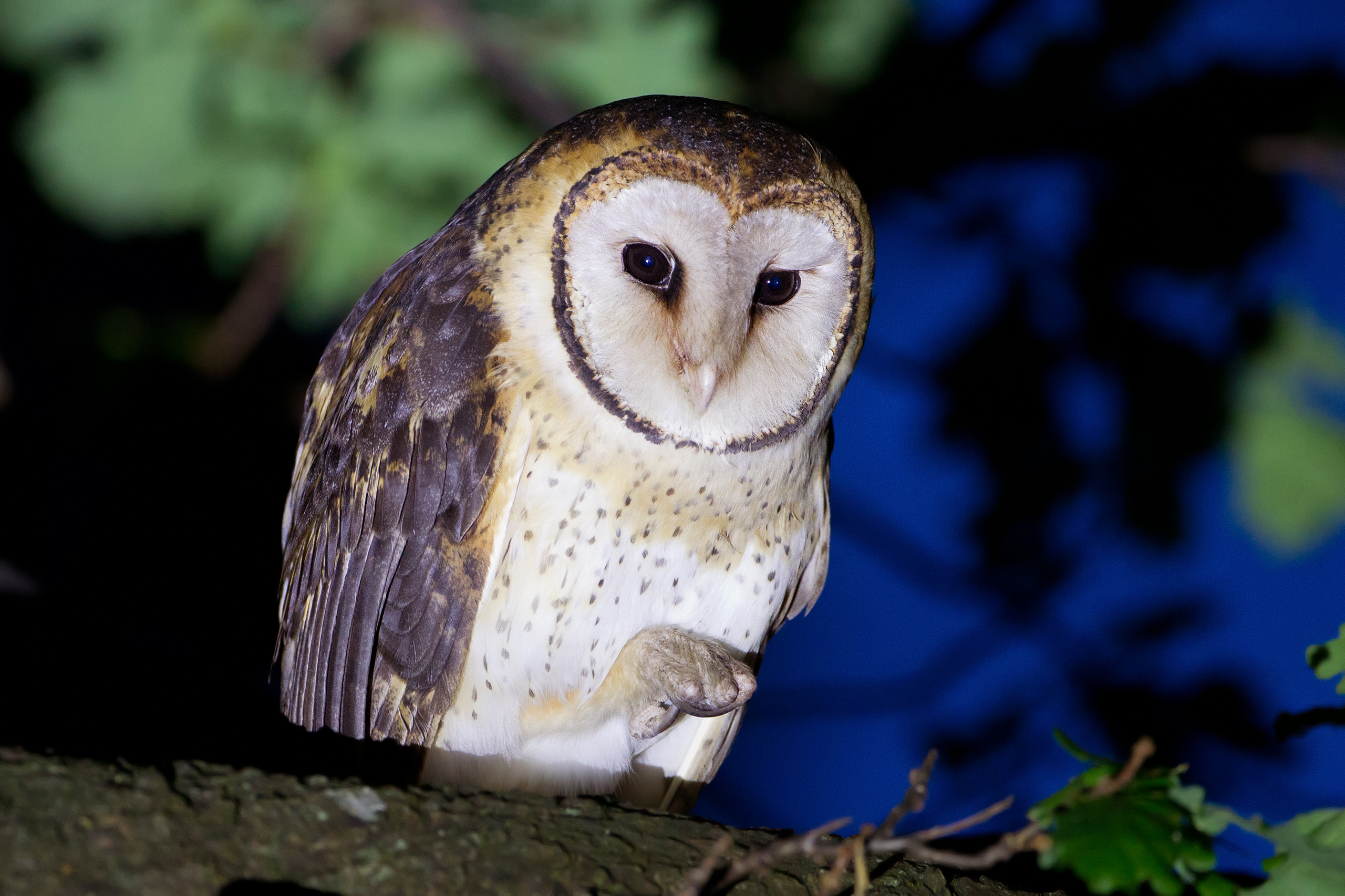
The Tasmanian masked owl is a large, forest-dwelling owl found only in Tasmania, and it lives a quieter, more specialized life than many people expect. It is strictly nocturnal, hunts mainly mammals rather than insects or birds, and depends heavily on mature forests with large tree hollows. This is not an owl that adapts easily to change. Its size, hunting style, and breeding needs all tie it closely to intact woodland ecosystems.
Despite its impressive wingspan and powerful build, the Tasmanian masked owl is rarely seen. It flies silently through forests at night, avoids direct competition with other predators, and nests in deep hollows that can take centuries to form. These habits make it well suited to its environment-but they also make it difficult for scientists to study and vulnerable to habitat loss. Understanding this owl means understanding Tasmania’s forests, because the two are closely linked. Where old trees disappear, this owl quietly disappears with them.
Physical Traits and Appearance
The Tasmanian masked owl is a large owl, and that size is immediately noticeable when compared with most other owls found in Australia. It has a heavy, broad-bodied shape rather than a slim or delicate one, reflecting its focus on hunting mammals rather than small, fast prey. The legs are thick and strong, and the feet are built to hold prey that does not give up easily. This is not an owl designed for speed but for control.
Scientific Classification
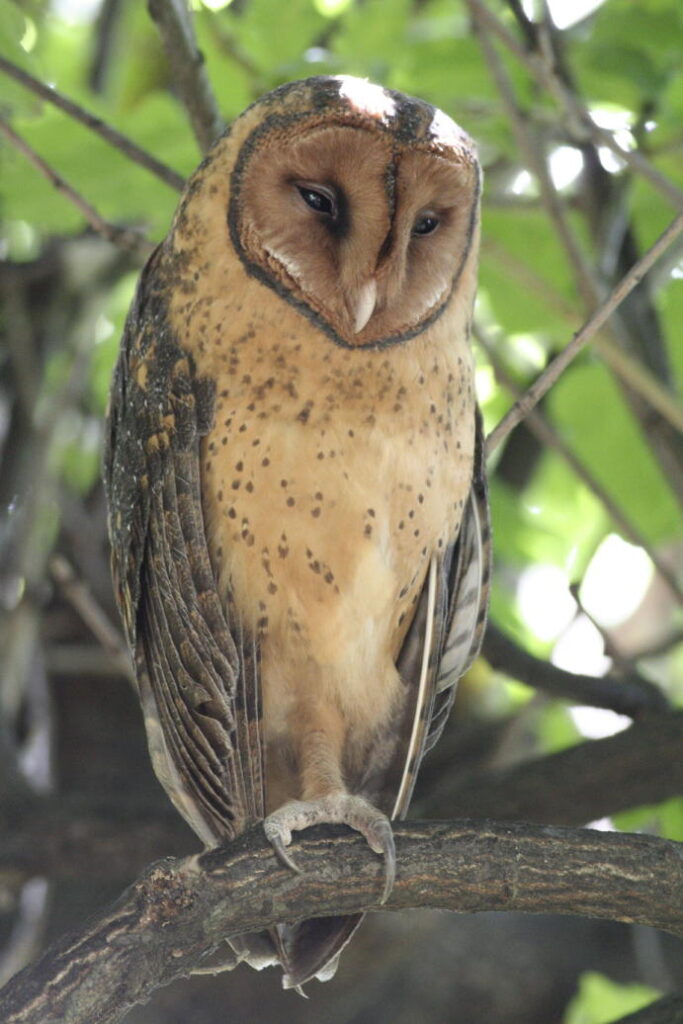
Its face is pale and rounded, forming a clear facial disc that contrasts with the darker feathers around it. This pale “mask” is where the owl gets its common name. The facial disc plays an important role in hearing, helping guide sound toward the ears so the owl can locate prey moving in darkness or under vegetation. In practice, this means the owl can rely on sound almost as much as sight when hunting at night. The eyes face forward and are well adapted to low light, giving the bird good depth perception without needing bright conditions.
The feathers on the upper body are usually pale brown to buff, marked with darker streaks and mottling. These markings help the owl blend into tree trunks and foliage when it is resting during the day. The underside is lighter and less strongly patterned, which reduces contrast when the bird is flying overhead at night. Nothing about the colouring is flashy. It is functional, shaped by the need to stay unnoticed both by prey and by potential disturbance during daylight hours.
Physical Measurements and Key Dimensions
| Female body length | Approximately 43–57 centimetres (17–22 inches), making females the larger sex. |
|---|---|
| Male body length | Approximately 35–42 centimetres (14–17 inches). |
| Maximum female weight | Up to about 1.26 kilograms (2.8 pounds), with body mass varying by condition and food availability. |
| Wingspan | Up to approximately 129 centimetres (51 inches), placing it among the largest owls in Australia. |
| Plumage tone | Predominantly brown to chestnut with pale speckling, generally darker than mainland Australian masked owl subspecies. |
| Legs and talons | Legs fully feathered to the feet, with strong toes and long talons adapted for gripping mammalian prey. |
Female Tasmanian masked owls are larger than males, a difference that becomes obvious when a pair is observed together. This size difference is common among owls and is thought to be linked to breeding, with larger females better suited to incubation and caring for young. The wings are broad and rounded, allowing the owl to fly slowly and quietly through forested areas. This silent flight is essential for a predator that depends on surprise rather than long chases.
Where It Lives in Tasmania
The Tasmanian masked owl is found nowhere else in the world. Its entire range is limited to Tasmania, and even within the island it is unevenly distributed. It does not occupy every forest, nor does it adapt easily to altered landscapes. What matters most is not the name of the forest type, but whether the forest is old enough to provide what the owl needs to survive.
This owl is most often associated with forested areas that still contain large, mature trees. These trees provide deep hollows used for nesting and daytime shelter, features that younger forests simply cannot replace. Dry eucalypt forests, wet forests, and wooded valleys can all support the species, but only when they retain older trees with suitable hollows. Without those structures, the habitat quickly becomes unusable for breeding.
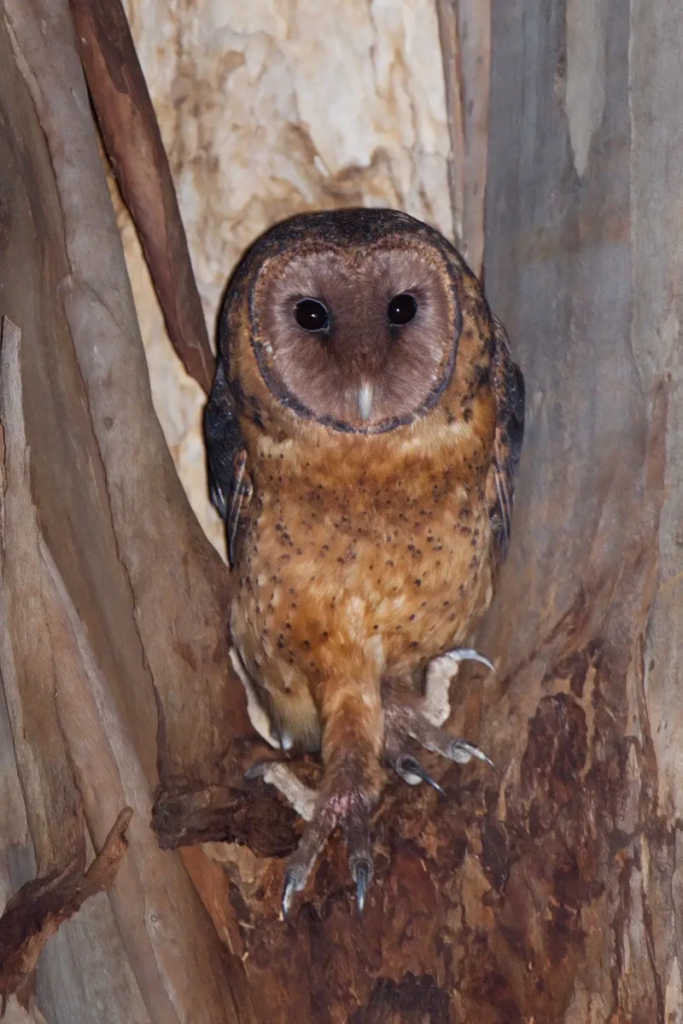
While the Tasmanian masked owl depends on forest cover, it does not spend all of its time deep within dense woodland. It commonly hunts along forest edges, open clearings, and quiet roadsides where prey is more active and easier to detect at night. These open areas are used for hunting, but they are not enough on their own. The owl still needs nearby intact forest for roosting during the day and for raising young.
Fragmented landscapes can be used for short periods, particularly for hunting, but they do not support stable populations over time. When forests are broken into smaller patches or when large hollow-bearing trees are removed, breeding opportunities decline. As a result, the distribution of the Tasmanian masked owl closely mirrors the distribution of remaining mature forests across the island.
Night-Time Behavior and Daily Activity
The Tasmanian masked owl is active almost exclusively at night. It usually leaves its daytime roost shortly after dusk and remains active until the early hours of the morning. During the day, it stays hidden in dense foliage or within tree hollows, where it is well sheltered from light and disturbance. Because of this, daytime sightings are uncommon and usually accidental rather than a sign of how many owls are present in an area.
Once night falls, the owl moves quietly through its territory, often flying low and slowly. Its flight is deliberate rather than fast, and it produces very little sound. This style of movement suits a hunter that depends on remaining unnoticed. Instead of chasing prey over distance, the owl listens carefully, glides into position, and makes short, decisive strikes.
Hunting activity is concentrated close to the ground, where mammals are most active after dark. The owl often works along forest edges, clearings, and open ground near cover, adjusting its movements based on sound rather than sight alone. When prey is scarce or conditions are poor, it may spend long periods perched and listening before making an attempt. This patient approach reflects a hunting strategy built around energy conservation rather than speed.
During daylight hours, the owl becomes almost completely inactive. It selects roosting sites that offer shade and concealment, remaining motionless for long periods. This quiet daytime behavior reduces the risk of disturbance and helps explain why the species can go unnoticed even in areas where it still occurs.
How This Owl Avoids Competition
The Tasmanian masked owl does not compete with other nocturnal predators in any obvious or aggressive way. Instead, it fits itself into a part of the night-time landscape where overlap is limited. Its preference for mammals as prey plays a large role in this. By focusing mainly on ground-dwelling mammals such as rodents and small marsupials, it avoids direct competition with owls that feed more heavily on insects or birds.
The way it hunts also reduces conflict. Rather than working high in the canopy or moving rapidly through dense forest, the owl often hunts close to the ground and along forest edges where mammals are active after dark. This keeps it working in slightly different places and at different heights than other predators using the same habitat. Over time, these small differences in prey choice and hunting space allow several nocturnal species to exist in the same area without regularly encountering one another.
This quiet separation is not something the owl actively plans. It is the result of long-term adaptation to a specific hunting role. By sticking to what it does best, the Tasmanian masked owl avoids competition simply by being consistent in its habits.
Breeding and Nesting Habits
Breeding in the Tasmanian masked owl is closely tied to the availability of suitable tree hollows. The species does not build a nest of its own. Instead, it relies on deep, naturally formed hollows in large, old trees. These hollows develop slowly over long periods of time, which means suitable nesting sites are limited and cannot be quickly replaced once lost. As a result, breeding opportunities are one of the main factors that limit population size.
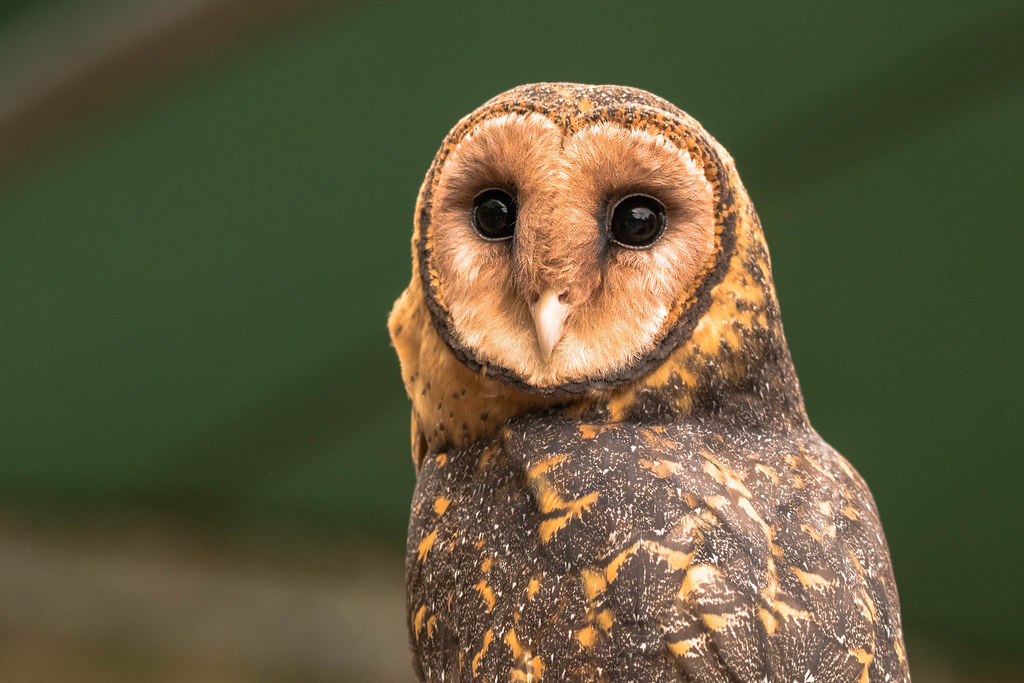
When a suitable hollow is available, eggs are laid directly onto the natural debris inside the cavity rather than on constructed nesting material. The female remains in the hollow for most of the incubation period, while the male takes on the role of hunting and delivering food. This division of labor continues after the chicks hatch, with the female staying close to the nest during the early stages of development.
Young owls remain in the hollow for a long period compared with many other birds. Even after they leave the nest, they continue to depend on the adults for food and protection. This extended period of care means that pairs do not breed frequently, especially if conditions are poor or food is limited. The slow pace of reproduction reflects a strategy focused on raising a small number of young successfully rather than producing large clutches.
Diet and Hunting Style
The Tasmanian masked owl is best described as a mammal hunter. Research based on prey remains and pellet analysis shows that mammals form the bulk of its diet. These include rodents and small to medium-sized native marsupials, which are active at night and move along the ground. Birds and insects are taken from time to time, but they make up a much smaller part of the owl’s overall food intake and are not what the species is adapted to hunt most efficiently.
Its hunting style reflects this preference. Rather than chasing prey through the air or darting between branches, the owl relies heavily on sound. It often hunts from a perch or while gliding slowly, listening for movement below. Once it detects prey, the strike is brief and direct, usually ending the hunt in a single movement. There is very little pursuit involved.
Most hunting takes place close to the ground, particularly along forest edges, clearings, and other open areas near cover. This approach allows the owl to conserve energy while waiting for the right opportunity. If prey activity is low, the owl may spend long periods listening without making an attempt. This patient, low-effort strategy suits a predator that depends on larger prey rather than frequent small catches.
Calls and Vocal Sounds
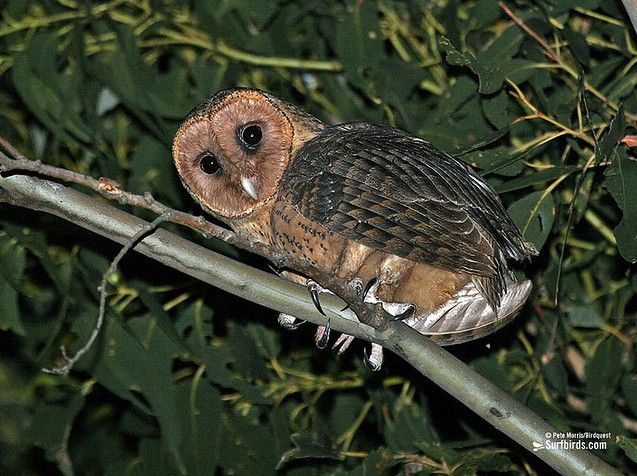
The Tasmanian masked owl is not often seen, but it is sometimes heard. Its calls are most noticeable during the breeding season, when adults use sound to keep in contact and to signal the presence of an occupied territory. Outside this period, the owl is generally quieter, which adds to the impression that it is rare even in areas where it still occurs.
Calls and Vocal Sounds
▾
The calls themselves are low and drawn out, carrying well through forested landscapes at night. This type of vocalisation suits dense woodland, where sound travels more reliably than visual signals. The owl usually calls from a concealed perch, remaining out of sight while the sound moves across the forest.
Because calling takes place almost entirely at night, many records of the Tasmanian masked owl come from sound rather than direct observation. For researchers and birders alike, hearing a call is often the only indication that the species is present in an area. This reliance on sound for detection has shaped much of what is known about the owl’s distribution and activity.
Conservation Status and Ongoing Threats
The Tasmanian masked owl is considered vulnerable largely because of its limited distribution and its strong reliance on mature forest environments. Being confined to Tasmania means there is no wider population elsewhere to buffer local declines. Within the island, suitable habitat is unevenly distributed and becoming increasingly fragmented, which places long-term pressure on the species.
Conservation Status
in Wild
Endangered
Threatened
Concern
Dependent
The most significant threat is the loss of large, hollow-bearing trees. These trees are essential for nesting and daytime shelter, yet they are often the first to be removed during logging or land clearing. Even when forest cover remains, the absence of suitable hollows can prevent owls from breeding successfully. This makes habitat quality just as important as habitat area.
Fragmentation further complicates the situation. As forests are broken into smaller patches, owls are forced to travel across open or disturbed areas while hunting. This increases the risk of vehicle collisions, particularly along quiet roads at night where prey activity is high. While some individuals can survive in altered landscapes, these conditions do not support stable populations over time.
Taken together, these pressures mean that the Tasmanian masked owl is not declining because of a single dramatic threat, but because of gradual changes to forest structure. The loss of old trees, reduced breeding opportunities, and increased risk during nightly movement all combine to place steady pressure on a species that reproduces slowly and depends on long-lived habitat features.
Why Scientists Still Struggle to Study This Owl Accurately
The Tasmanian masked owl is difficult to study not because scientists lack interest, but because the bird itself leaves very little behind to work with. It occurs at low densities, moves almost entirely at night, and spends the day hidden in tree hollows or dense foliage. Even in areas where it is present, weeks or months can pass without a single visual record.
Most information about the species comes from listening rather than watching. Researchers often rely on call surveys to confirm presence, especially during the breeding season when vocal activity increases. While these surveys are useful, they do not provide clear information about how many owls are present or how individuals move across the landscape. Hearing an owl confirms that it is there, but not how many there are.
Breeding adds another layer of difficulty. Nest sites are hard to find, often located high in old trees and used infrequently. Long gaps between breeding attempts mean that opportunities to gather data are limited. Because of these constraints, scientists tend to describe population size and trends cautiously. Much of what is known comes from piecing together small amounts of information over long periods, rather than from continuous monitoring.