
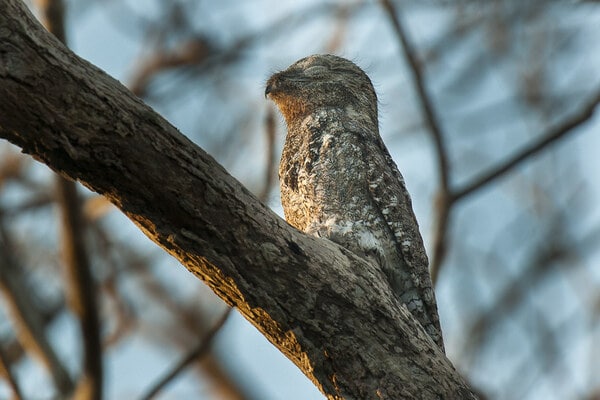
Many people search for “potoo owls,” but one thing needs to be clear from the start: potoos are not owls. They only look a little owl-like because they are nocturnal and have large, expressive eyes. Scientifically, potoos belong to the family Nyctibiidae, which is closer to nightjars than to any owl species. Understanding this helps make sense of their unusual behavior and anatomy.
Potoos survive by blending into their surroundings. During the day, a potoo stands perfectly still on a broken branch, matching the texture of tree bark so closely that even trained observers sometimes miss it. At night, the bird becomes active, gliding slowly through forest openings and catching moths and beetles with its remarkably wide mouth. Its soft, haunting calls carry through the forest and are one of the most recognizable traits of the group.
These birds live from southern Mexico to northern Argentina, depending on the species, and they nest very simply-usually placing one egg in a natural depression on a branch. Most potoo species remain stable, but they depend heavily on forest cover, meaning deforestation and human disturbance can affect where they can perch, hunt, and raise their young.
Physical Morphology
Potoos have a very distinctive build that suits their nighttime way of living. The first thing most people notice is their eyes. They are unusually large for a bird of this size, and this helps them see clearly in low light as they move through dim forest openings after dark. Their feathers add another layer to their survival strategy. Each feather carries a mix of browns, grays, and fine markings that look almost identical to the surface of tree bark, which is why a resting potoo often disappears into the branch it is sitting on.
Their face can be surprising on closer look. The bill appears small and modest when closed, but the mouth can open far wider than expected. This wide gape is what allows a potoo to catch flying insects with quick, precise movements. Their legs and feet tell a different story from owls. Instead of strong talons, potoos have small feet that are made simply for perching rather than gripping or killing prey. Everything about their structure reflects an insect-hunting specialist rather than a bird of prey.
How the Potoo Uses Its Wide Mouth to Hunt
A potoo spends much of the night perched quietly, letting the darkness settle around it while it waits for insects to move through the open spaces between the trees. It rarely wastes energy. Instead, it watches for the faint flutter of a moth or the steady flight of a beetle.
When something comes close enough, the potoo lifts off in a short, deliberate burst and meets the insect in the air. The moment its bill opens, the mouth reveals its true size. What looks like a small beak during the day becomes a wide, sweeping opening that can easily catch a flying insect in motion.
This is the same feeding style seen in nightjars, and it suits the potoo well because it allows the bird to gather food with only brief, precise movements. The entire hunting process depends on patience, a clear line of sight, and that unexpectedly large mouth, which is perfectly shaped for catching the insects that fill the nighttime forest.
How Potoos Differ from True Owls in Structure
Although people often call them potoo owls, their bodies tell a very different story. Owls are built as predators. They have powerful talons that can hold and kill prey, and their beaks curve into a sharp hook made for tearing into vertebrates. Potoos, on the other hand, do not have any of these features.
Their feet are small and not suited for gripping animals, and their beak is short and soft compared to that of an owl. When you look at their head and mouth structure, they resemble nightjars far more than any owl. Their wide gape is designed for catching insects in flight rather than for handling larger prey.
Even the way they move reflects their lifestyle. Owls fly with a strong, silent stroke to ambush their targets, while potoos take short, measured flights to intercept insects. Everything about the potoo’s structure points to a bird that hides, waits, and feeds on insects, not one that hunts vertebrates like an owl would.
Geographic Range
Potoos are distributed across the Neotropics, where conditions support high insect diversity and forest structure suitable for their camouflage. Their range stretches from southern Mexico through Central America and across a broad sweep of South America, reaching as far south as northern Argentina. Each species has its own geographic envelope, with the Great Potoo and Common Potoo being the most widespread.
Where Potoos Actually Live Across the Americas
Depending on the species, potoos occur in countries including:
- Mexico
- Guatemala, Belize, Honduras, Nicaragua, Costa Rica, Panama
- Colombia, Venezuela, Ecuador, Peru
- Brazil, Bolivia, Paraguay
- Northern Argentina
Their presence depends on suitable forest habitats rather than temperature alone, making habitat loss a major influence on distribution.
Habitat Use
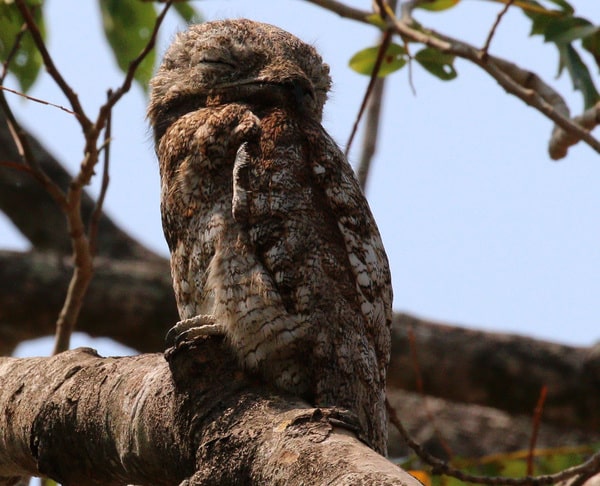
Potoos are strongly tied to forested landscapes, and much of their behavior depends on finding the right kind of perch. They often choose exposed branches or old broken stumps where they can sit upright and blend into the background during the day. These spots also give them a clear view of the surrounding space once night falls.
Forest edges and natural openings are especially helpful because they attract the flying insects that potoos depend on. When a habitat has a mix of mature trees, scattered gaps, and enough quiet space for roosting, it can support healthy potoo activity. If those elements begin to disappear, the bird’s ability to feed and raise a chick becomes harder, since both their camouflage and their hunting style rely on the structure of the forest around them.
Behavioral Patterns
Potoos follow a very clear rhythm, shaped almost entirely by the day–night cycle. They spend the daylight hours pressed against a branch in a still and upright pose that makes them look like part of the tree itself. This posture, combined with their bark-like feathers, is so effective that many observers walk past them without noticing.
Once night settles in, their world becomes more active. They leave their daytime perch and begin feeding, moving in short, controlled flights to catch insects passing through patches of open air. Their voices also become more noticeable at this time.
Each species has its own call, often described as haunting or echoing, and these sounds help them communicate across the forest when visibility is low. During the day they avoid unnecessary movement, since even a small shift could reveal them to predators. Their behavior is built around efficiency and concealment, with most activity saved for the hours when darkness offers both protection and opportunity.
Reproductive Cycle
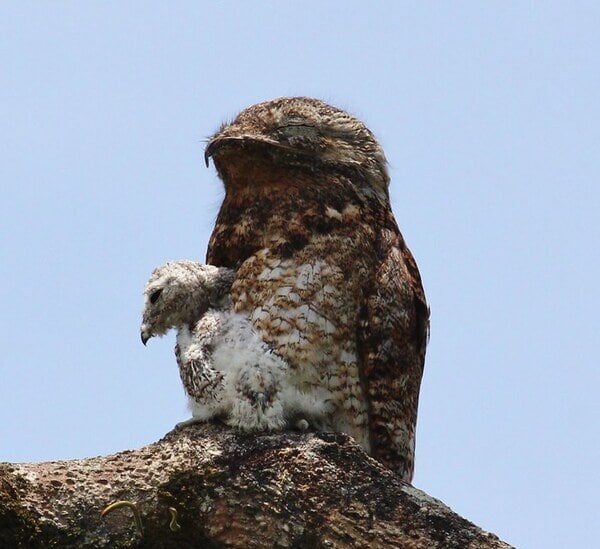
Potoos follow a very minimal nesting approach that reflects their reliance on camouflage. Instead of gathering materials or shaping a nest, they simply place a single egg in a small depression found naturally on a branch. This simple arrangement works because the adult blends so completely with the perch that predators often overlook both bird and egg.
Incubation can involve one or both parents depending on the species, and the adult remains steady and upright throughout, using stillness as protection. When the chick hatches, it stays on the same spot, resting against the adult until it is strong enough to fly.
The young bird gains safety from the same strategy that protects the adults, relying on camouflage and the parent’s posture rather than elaborate nest construction. This quiet and unobtrusive approach is typical of the family and shows how closely their breeding behavior is tied to the structure of their habitat.
Feeding Ecology
Their diet is almost entirely made up of flying insects, especially moths and beetles. Potoos rely on perch-hunting rather than active pursuit, conserving energy across long nights. Their dependence on a healthy insect population links them to ecosystems with stable forest structures and limited pesticide use.
Primary diet components:
- Moths
- Beetles
- Other nocturnal flying insects
Conservation Status
Most species of potoos are currently classified as Least Concern by the IUCN, which means they are not facing immediate global risk. This can be a little misleading, because their overall stability does not always reflect what is happening in smaller regions. In places where forests are being cleared or broken into smaller patches, potoos can lose the tall perches and quiet roosting sites they depend on.
Some species feel these changes more strongly than others. The Rufous Potoo, for example, lives within a narrower range and is more sensitive to disturbances in its habitat. While the group as a whole is not considered threatened, their long-term security is closely tied to the preservation of healthy, continuous forest, and any decline in that habitat can influence their local populations more than broad assessments might suggest.
Human Disturbance Effects
Human activity impacts potoos mainly through habitat alteration. When forests are cleared or thinned, the number of suitable perches decreases, and insect availability can drop. Artificial lights may alter insect movement patterns, affecting how and where potoos feed. Noise and disturbance can also interfere with nocturnal calling, which is crucial for territory and breeding.
Main disturbance factors:
- Deforestation and habitat fragmentation
- Reduced insect populations
- Light pollution altering insect behavior
- Loss of roosting and nesting sites