
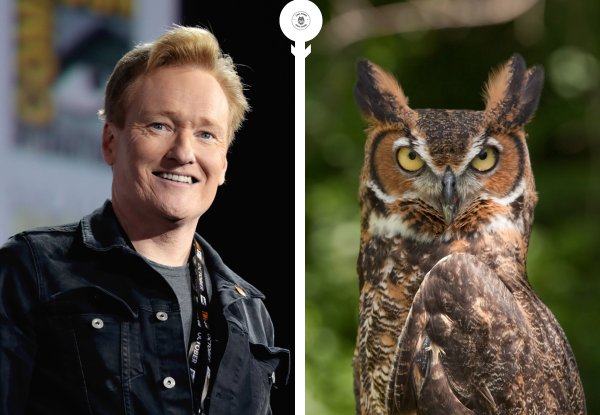
When a Great Horned Owl appeared on Conan O’Brien’s show, it did not panic, perform, or react the way a television guest normally would. It simply sat there, calm and watchful, as if late night television was none of its concern. That calm was not an act. It was biology doing exactly what biology does best.
Great Horned Owls are designed to remain still for long periods, conserving energy while quietly observing everything around them. A late night studio with dim lighting, controlled movement, and a stable perch closely matches the conditions these owls experience while hunting. To the audience, the owl looked relaxed. In reality, it was alert, focused, and completely uninterested in human cues.
That is why the moment felt like the owl had taken over the show. While comedy depends on timing and reactions, the owl followed a different set of rules. It responded only to what mattered in its world. The humor came not from chaos, but from watching a wild predator calmly ignore the idea that television requires participation. Viewers laughed, learned something real about owl behavior, and witnessed a rare moment where nature quietly refused to play along.
Why This Great Horned Owl Looked Too Relaxed for a Late Night TV Show
To viewers, the Great Horned Owl appeared almost too comfortable sitting under studio lights on a late night show. Late night television usually thrives on energy, noise, and reaction, yet the owl seemed unmoved by all of it. This calm did not come from training or familiarity with fame. It came from how this species is built to exist in the world.
Great Horned Owls are nocturnal ambush predators that rely on stillness as a survival tool. In the wild, they can remain motionless for long periods while quietly observing their surroundings. That behavior carries over into any environment that does not register as a threat. A controlled studio setting with dim lighting, limited sudden movement, and a stable perch can feel surprisingly familiar to an owl whose instincts are tuned for night hunting rather than social interaction.
Professional animal handlers also play a major role in shaping what the audience sees. When raptors appear on television, they are not encouraged to move or perform. They are positioned in a way that minimizes stress and allows them to remain in a natural posture. The owl was not relaxed because it was entertained. It was calm because nothing in the environment required a response.
What made the moment funny was the contrast between human expectations and animal reality. People expect visible emotion, acknowledgment, or engagement. The owl offered none of that, not out of stubbornness, but because Great Horned Owls do not react unless something matters to their survival. In staying still and unreadable, the owl was doing exactly what evolution trained it to do.
When Conan O’Brien Realized the Guest Wasn’t Taking Any Cues
Late night comedy depends on rhythm and reaction. Hosts speak, guests respond, and the audience feeds energy back into the moment. That rhythm quietly fell apart once it became clear that the owl was not responding to timing, tone, or attention. The bird did not flinch, shift, or acknowledge the performance happening around it.
This is where the segment subtly changed shape. Instead of the show guiding the interaction, the owl set the pace simply by refusing to engage with human social rules. Facial expressions, jokes, and applause have no meaning to a solitary nocturnal raptor. The owl’s attention stayed fixed on its surroundings, not on the host or the crowd.
For Conan O’Brien, the realization became part of the humor. There was nothing to correct and nothing to escalate. The owl was not nervous, aggressive, or confused. It was present, alert, and entirely uninterested in participating. That mismatch created a moment of genuine unscripted comedy.
The owl did not dominate the segment by being disruptive. It dominated by being unmovable. In a format built on reaction, the absence of reaction became the joke. What viewers witnessed was not a failed animal appearance, but a brief moment where live television had to adapt to a wild animal that followed a completely different set of rules.