
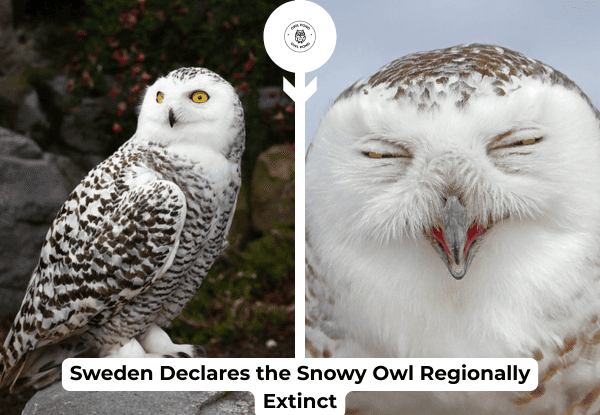
For those of us who spend our time writing about owls, this news is genuinely hard to take in.
The Snowy Owl is not just another species. It is one of the most recognizable birds in the world. With its bright white feathers and intense yellow eyes, it has always felt like a symbol of the Arctic itself. So learning that Sweden has now lost this bird as a breeding species feels deeply unsettling.
And to be honest, a little heartbreaking.
A Disappearance That Happened Quietly
What stands out most is how quietly this happened.
Snowy Owls were never extremely common in Sweden, but they were part of the landscape, especially in the northern mountains. In the 1970s, there were even periods when hundreds of pairs nested successfully.
Over time, those numbers began to drop.
By 2015, there were no clear signs of successful breeding. No chicks, no confirmed nests. Just occasional sightings that became less meaningful with each passing year. Now, after nearly a decade without reproduction, conservation groups have officially declared the Snowy Owl regionally extinct in Sweden.
It is not gone globally, but it has disappeared from a place it once called home.
A Species Already Under Pressure
Across the world, the Snowy Owl is already facing challenges. Current estimates suggest there are only around 14,000 to 28,000 individuals left in the wild, and the species is listed as vulnerable.
That is not a comfortable position for any bird, especially one that depends so heavily on a specific environment to survive.
Human activity has certainly contributed. Habitat disturbance, development, and past hunting have all played a role. But these are only part of a much bigger picture.
When the Food Source Disappears
One of the most important parts of the Snowy Owl’s survival comes down to a small animal many people rarely think about. Lemmings.
When lemming populations are strong, Snowy Owls can breed successfully. When they are not, the owls often skip breeding altogether.
Lemmings depend on stable snow cover during winter to create tunnels and stay protected. With warmer winters becoming more common, that snow is no longer reliable. It can melt, refreeze, or fail to build up properly.
As a result, lemming numbers drop. And without enough food, Snowy Owls simply cannot raise their young.
A Changing Arctic
The Arctic is warming faster than any other region on Earth. In some areas, temperatures are rising several times quicker than the global average.
This is not just about warmer air. It is about entire ecosystems shifting in ways that are difficult to reverse.
The Snowy Owl is built for cold, open landscapes. But even a species this well adapted cannot keep up when those conditions begin to disappear.
Why This Feels Personal
As a site dedicated to owls, we spend a lot of time appreciating these birds. We write about where they live, how they hunt, and why they matter.
But stories like this are different.
It is one thing to admire a species. It is another to watch it slowly vanish from a place where it once thrived.
There is still hope that Snowy Owls could return to Sweden one day if conditions improve. But for now, their absence is a reminder that even the most iconic wildlife is not guaranteed a future.
And that is something worth paying attention to.